Properties (15)
- purpleRed
- (Black et al., 2026)
Misophonia symptom severity is linked to impaired flexibility and heightened rumination
Status:: #status/reviewed
Metadata
- Item Type: #journalArticle
- Authors:: Vivien K. Black, Kenneth J.D. Allen, Hashir Aazh, Sheri L. Johnson, Mercede Erfanian,
- Date:
- Date Added: 1773875659000
- URL: https://bpspsychub.onlinelibrary.wiley.com/doi/10.1111/bjop.70025
- DOI: 10.1111/bjop.70025
- Cite Key: blackMisophoniaSymptomSeverity2026
- Topics: [object Object]
- Tags:: #reviewed, #Misophonia, #rumination, #affective-flexibility, #cognitive-flexability,
- PDF Attachments
Abstract
| Background/Purpose | Background- • Misophonia prevalence estimates range from 4.6% to 20%; not formally recognized in DSM-5-TR or ICD-11. • Trigger sounds and related sensory stimuli evoke autonomic arousal and altered neural activity in emotion processing, salience, and motor control regions. • Executive functioning deficits documented in misophonia across cognitive control, response bias, emotion regulation, and attentional processing. • Individuals with misophonia show hyperfocus on triggers, selective attention deficits, and hypervigilant anticipation consistent with attentional set-shifting impairment. • Prior self-report evidence indicates higher cognitive inflexibility in misophonia (Simner et al., 2021), but task-based studies (e.g., WCST) have not replicated this finding. • Null task-based findings may reflect: (a) inconsistent construct definitions, (b) methodological biases, (c) trigger-specificity of deficits, (d) low self-report/task correspondence, or (e) use of emotionally neutral stimuli insufficient to evoke flexibility impairments. • Misophonia shows substantial comorbidity with OCD, ASD, PTSD, ADHD, and AN — disorders frequently associated with cognitive inflexibility. • Task-switching deficits in ASD are specific to emotional stimuli, supporting the relevance of affective flexibility as a construct in misophonia. • Rumination is a transdiagnostic process linked to cognitive and affective inflexibility; misophonic individuals anecdotally report rumination surrounding triggers but broader ruminative tendencies are untested. Purpose- • Primary: evaluate whether task-based affective flexibility (MAFT switch accuracy and RT) is associated with misophonia severity (H1). • Secondary: replicate the association between self-reported cognitive inflexibility (DFlex) and misophonia severity (H2). • Exploratory: examine whether self-reported cognitive inflexibility converges with task-based affective flexibility (H3). • Examine whether multiple subtypes of rumination are associated with misophonia severity (H4), affective flexibility (H5), and cognitive flexibility (H6). • Explore whether rumination mediates the relationship between cognitive inflexibility and misophonia severity. |
| Participants/samples | • N = 140 (final analytic sample); mean age ≈ 30 years; 49 female, 91 male. • Recruited via Prolific (n = 128) and misophonia-specific newsletters/soQuiet/Misophonia International (n = 12). • Age range 18–45; inclusion criteria: no hearing loss, no cognitive impairment/dementia, normal or corrected-to-normal vision, English fluency, no current psychiatric diagnosis. • 25% of total sample (n = 35) met S-Five clinical threshold for significant misophonia (score ≥ 87); 91.67% of newsletter volunteers met threshold vs. 18.75% of Prolific participants. • Gender differed significantly between clinical and sub-clinical misophonia groups; females overrepresented in significant-misophonia group. • Study pre-registered on OSF prior to data collection. |
| Measures | • MAFT (Allen et al., 2025): neurocognitive task; switch accuracy and switch RT are primary affective flexibility indices; stimuli from IAPS (positive, negative, neutral blocks); administered via Inquisit Web. • S-Five (Vitoratou et al., 2021): 25-item self-report; total score and five subscales (externalizing, internalizing, impact, threat, outburst); 10-point scale; clinical threshold = 87; α = .96 in current sample. • DFlex flexibility subscale (Roberts et al., 2011): 12-item self-report cognitive inflexibility measure; 6-point Likert; higher scores = greater inflexibility; α = .83. • PTQ (Ehring et al., 2011): 15-item measure of perseverative/repetitive negative thinking; 5-point Likert; α = .95. • RRS-B (Treynor et al., 2003): 5-item brooding subscale; 4-point Likert; α = .81. • ARS (Sukhodolsky et al., 2001): 19-item anger rumination scale; 4-point Likert; α = .93. • SAD-T (Aazh, Hayes, et al., 2022): 4-item anxiety/depression screener validated in auditory disorder samples; covariate; α = .90. • SSSQ (Aazh & Kula, 2024): 6-item hyperacusis/sound sensitivity screener; covariate; α = .77. |
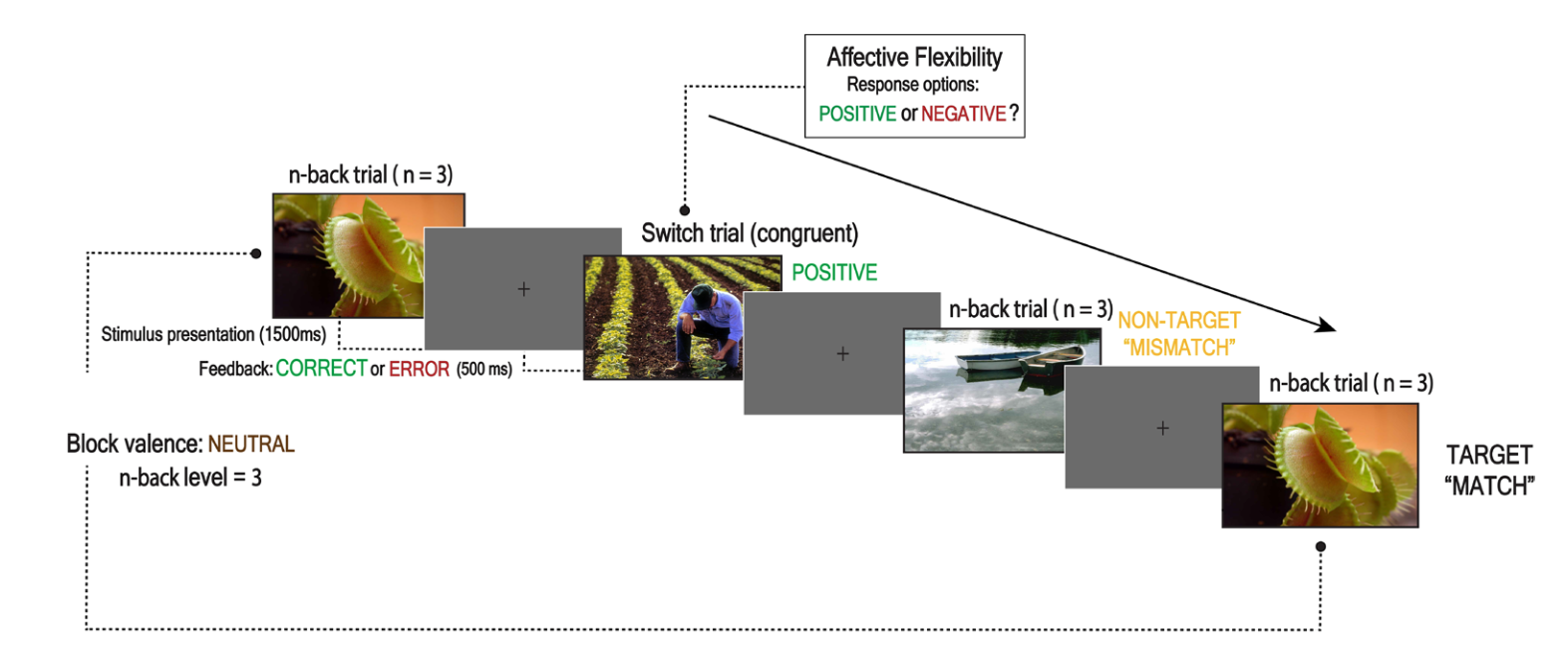
| Procedures | • Participants completed MAFT via Inquisit Web followed by questionnaire battery via Qualtrics (S-Five, DFlex, PTQ, RRS-B, ARS, SAD-T, SSSQ). • MAFT: 198 trials in nine blocks (three valence conditions × three N-back difficulty levels); stimuli presented 1500ms with 500ms fixation cross ITI; switch trials required positive/negative valence judgment; participants practiced until ≥70% N-back accuracy. • Seven attention check items embedded (one per questionnaire); no participants failed two or more checks. • Total study duration approximately 40–45 minutes. • Prolific participants compensated at ~$9.58/hour equivalent; newsletter volunteers uncompensated. • Exclusions: incomplete MAFT (n = 20), multiple MAFT attempts (n = 1), incomplete questionnaires (n = 2). |
| Results | Affective flexibility (MAFT) and misophonia severity • Switch accuracy was inversely associated with total misophonia severity, and specifically with internalizing, impact, and outburst subscales; no association with externalizing or threat subscales. • Switch RT was not associated with misophonia severity on any subscale or total score; excluded from multivariate models. • The switch accuracy–misophonia relationship remained significant after controlling for cognitive inflexibility (DFlex), gender, hyperacusis, and depression/anxiety, supporting specificity to affective flexibility. • Group comparison: participants with clinically significant misophonia showed worse switch accuracy than those without; no group difference in switch RT. Cognitive flexibility (DFlex) and misophonia severity • Higher cognitive inflexibility (DFlex) was associated with greater misophonia severity on total score, externalizing, impact, and outburst subscales; associations with internalizing and threat were marginal or non-significant after covariate adjustment. • Findings replicate and extend Simner et al. (2021). Relationship between affective and cognitive flexibility • No significant association between MAFT switch accuracy or switch RT and DFlex scores; H3 not supported. • Affective and cognitive flexibility treated as independent constructs in subsequent models. Rumination and misophonia severity • All three rumination subtypes (PTQ, RRS-B, ARS) were positively associated with total misophonia severity and all five S-Five subscales, controlling for gender, hyperacusis, and depression/anxiety; H4 supported. • Rumination–misophonia associations persisted after outlier exclusion. Rumination and flexibility • No significant association between MAFT switch accuracy or RT and any rumination subtype; H5 not supported. • DFlex was positively associated with all three rumination subtypes controlling for covariates; H6 supported. Mediation analyses (exploratory) • The relationship between cognitive inflexibility and misophonia severity was significantly mediated by all three rumination subtypes (PTQ, RRS-B, ARS); each mediation remained significant after covariate adjustment. • Rumination accounted for approximately 39%–43% of the total effect of cognitive inflexibility on misophonia severity. • Covariates (gender, hyperacusis, depression/anxiety) were significant in multiple models. |
| Discussion/Limits | Conclusion- • The authors conclude that misophonia is associated with a distinct cognitive profile characterized by both affective inflexibility (executive function level) and cognitive inflexibility (trait/psychological level), operating as independent mechanisms. • The findings indicate that task-based affective flexibility deficits in misophonia are not reducible to general cognitive inflexibility, suggesting stimulus-context specificity tied to emotional content. • The authors conclude that the observed affective switching impairment is consistent with Task-Set Reconfiguration and Task-Set Inertia theories, implicating difficulties in reconfiguring emotional task sets and susceptibility to interference from prior task sets. • The findings indicate that OFC hyperactivation documented in misophonia may underlie impaired behavioral inhibition relevant to affective set-switching performance. • The authors conclude that elevated rumination in misophonia extends beyond trigger-specific situations, reflecting a general transdiagnostic tendency toward perseverative thinking. • The findings indicate that the rumination–misophonia relationship cannot be explained by comorbid anxiety, depression, or hyperacusis, suggesting a unique association. • The authors conclude that cognitive inflexibility and rumination are mutually reinforcing mechanisms; rumination partially mediates the effect of cognitive inflexibility on misophonia severity. • The data support a broader contextual rigidity in misophonia resembling profiles observed in ASD, OCD, and AN, consistent with the documented comorbidity pattern. • The findings indicate that perseverative thinking, as a treatment-amenable process, may be a viable target in CBT-based interventions for misophonia. • The authors conclude that misophonia may involve not only heightened sensory sensitivity but also disruptions in self-regulation that may either contribute to or arise from misophonic reactivity. |
| Limitations:: | • No non-affective cognitive flexibility task included; cannot definitively distinguish affective-specific from general task-switching deficits. • Exclusion criteria relied on self-report; undetected comorbidities may have influenced results. • Mixed recruitment sample (Prolific + symptomatic newsletter volunteers) may inflate severity estimates and introduce sampling bias. • Self-report measures vulnerable to introspective and social desirability bias. • Cross-sectional design precludes causal inference; direction of effects between inflexibility, rumination, and misophonia remains undetermined. • Some analyses were exploratory and require replication. |
| Future Directions:: | • Include a non-affective switching task matched for cognitive demand to isolate specificity of affective flexibility deficits. • Use diagnostically verified or uniformly recruited samples to reduce sampling heterogeneity. • Employ multi-method approaches to clarify whether cognitive and affective flexibility are truly separable constructs. • Longitudinal or experimental designs needed to establish causal direction among inflexibility, rumination, and misophonic reactivity. • Stratify analyses by recruitment source or use matched sampling designs. |
| Relevance:: | • cited by (Woolley et al., 2026) as supporting a role of rumination in misophonia • looked at the relationship between Misophonia and affective flexibility, cognitive flexibility and rumination • cited by (Woolley et al., 2026) as supporting a role of rumination in misophonia • findings suggest that Misophonia mechanisms are not specific to triggers |
Notes
key terms and concepts
- misophonia – disorder characterized by decreased tolerance to certain sounds (orofacial, human-based, or environmental), evoking strong emotional reactions (anger, irritation, disgust, anticipatory anxiety) and significant functional impairment.
- affective flexibility – cognitive shifting ability in the face of emotion-evoking stimuli; operationalized here via switch accuracy and switch RT on the MAFT.
- cognitive flexibility – capacity to efficiently shift between mental processes to produce contextually appropriate behavioral responses; assessed via self-report (DFlex).
- rumination – repetitive, self-focused thought related to negative emotions and their origins; assessed across three subtypes: perseverative thinking (PTQ), brooding (RRS-B), and anger rumination (ARS).
- MAFT (Memory and Affective Flexibility Task) – novel neurocognitive task incorporating N-back working memory trials and emotional switch trials using IAPS stimuli; switch accuracy is the primary affective flexibility index.
- S-Five (Selective Sound Sensitivity Syndrome Scale) – validated 25-item multidimensional self-report tool measuring misophonia severity across five domains: externalizing, internalizing, impact, threat, and outburst.
- switch cost – performance decrement (reduced accuracy or slower RT) observed on trials requiring a shift from one task set to another, used as an index of cognitive or affective inflexibility.
- decreased sound tolerance (DST) – broader umbrella category encompassing misophonia and hyperacusis; the two conditions share symptoms but are considered fundamentally distinct.
-
Task-Set Reconfiguration (TSR) – theory proposing that switch costs arise from the cognitive effort required to reconfigure a new task set during switch trials, a process reliant on endogenous top-down control mechanisms. In the misophonia context, documented impairments in cognitive control when confronted with trigger sounds suggest that the reconfiguration process is specifically vulnerable, and Black et al. argue that larger emotion switch costs in misophonic individuals may reflect difficulty assembling a new emotional task set during affective switching.
-
Task-Set Inertia (TSI) – theory proposing that switch costs arise from interference caused by residual activation of the previous task set, reflecting carryover from prior cognitive states rather than active reconfiguration failure. In the misophonia context, Black et al. suggest that heightened susceptibility to this carryover interference may mean that misophonic individuals have particular difficulty disengaging from a prior task set when transitioning into an emotionally demanding one, consistent with the broader pattern of attentional hyperfocus and disengagement difficulty documented in the disorder.
my engagement notes
my questions
my comments
Bookmarks
-
bookmark for Rumination: a key process related to inflexibility, potentially involved in misophonia (page 4)
-
Memory and Affective Flexibility Task (MAFT) (page 6)
-
Selective Sound Sensitivity Syndrome Scale (S-Five;) (page 7)
-
Detail and Flexibility Questionnaire (DFlex) (page 8)
-
Screening for Anxiety and Depression in Tinnitus-Hyperacusis-Misophonia (SAD-T) (page 9)
-
Sound Sensitivity Symptoms Questionnaire (SSSQ) (page 9)
-
talking about the two primary categories of explanations for the observed increased switch cost in Misophonics (page 21)
reading notes
contextual statement
In a 2026 study, Black et al. investigated the relationships between misophonia severity and affective flexibility, cognitive flexibility, and rumination, employing the Memory and Affective Flexibility Task (MAFT), a novel neurocognitive paradigm that embeds affective task-switching demands within an N-back working memory structure using emotionally valenced images, alongside a battery of self-report measures in a sample of 140 adults.
summary statement
In a 2026 study, Black et al. examined whether misophonia severity is associated with affective flexibility, cognitive flexibility, and rumination by administering a novel neurocognitive switching task (MAFT), self-report flexibility and rumination measures, and the S-Five misophonia severity scale to 140 adults recruited via Prolific and misophonia-specific newsletters. They found that greater misophonia severity was associated with lower switch accuracy on affective trials (but not reaction time), higher self-reported cognitive inflexibility, and greater perseverative, brooding, and anger rumination — with the latter two constructs operating independently of task-based affective flexibility and with rumination partially mediating the inflexibility–misophonia relationship. From this they concluded that misophonia involves a dual-level rigidity profile encompassing executive-level affective switching difficulty and broader trait-level cognitive inflexibility and ruminative tendencies, which extend beyond trigger-specific contexts and may represent transdiagnostic mechanisms warranting targeted clinical intervention.
zettlekasten
the theoretical basis for the Misophonia cognitive rigidity link
explaining inconsistencies on findings of the role of cognitive flexibility in Misophonia
findings suggest that Misophonia mechanisms are not specific to triggers
explaining observed affective switching costs in Misophonia via TSR and TSI theory
affective switching deficits in Misophonia related to function of OFC
The severity of misophonia is linked to elevated rumination tendencies
Rumination is linked to cognitive inflexibility yet unrelated to affective inflexibility