Properties (15)
- purpleRed
- Reducing hyper mirroring in misophonia
- (Dheerendra et al., 2025)
- z
•
Reducing hyper mirroring in misophonia: A proposal for cortico-cortical paired associative stimulation (ccPAS) as a potential intervention for treatment
Status:: #status/reviewed
Metadata
- Item Type: #journalArticle
- Authors:: Pradeep Dheerendra, Sukhbinder Kumar, Phillip E. Gander, Joel I. Berger, Lars F. Muckli,
- Date:
- Date Added: 1764877418000
- URL: https://linkinghub.elsevier.com/retrieve/pii/S0306987725002798
- DOI: 10.1016/j.mehy.2025.111840
- Cite Key: dheerendraReducingHyperMirroring2025
- Topics: [object Object]
- Tags:: #Misophonia, #reviewed, #Highlighted-source, #treatment, #TMS, #mirror-system,
- PDF Attachments
Abstract
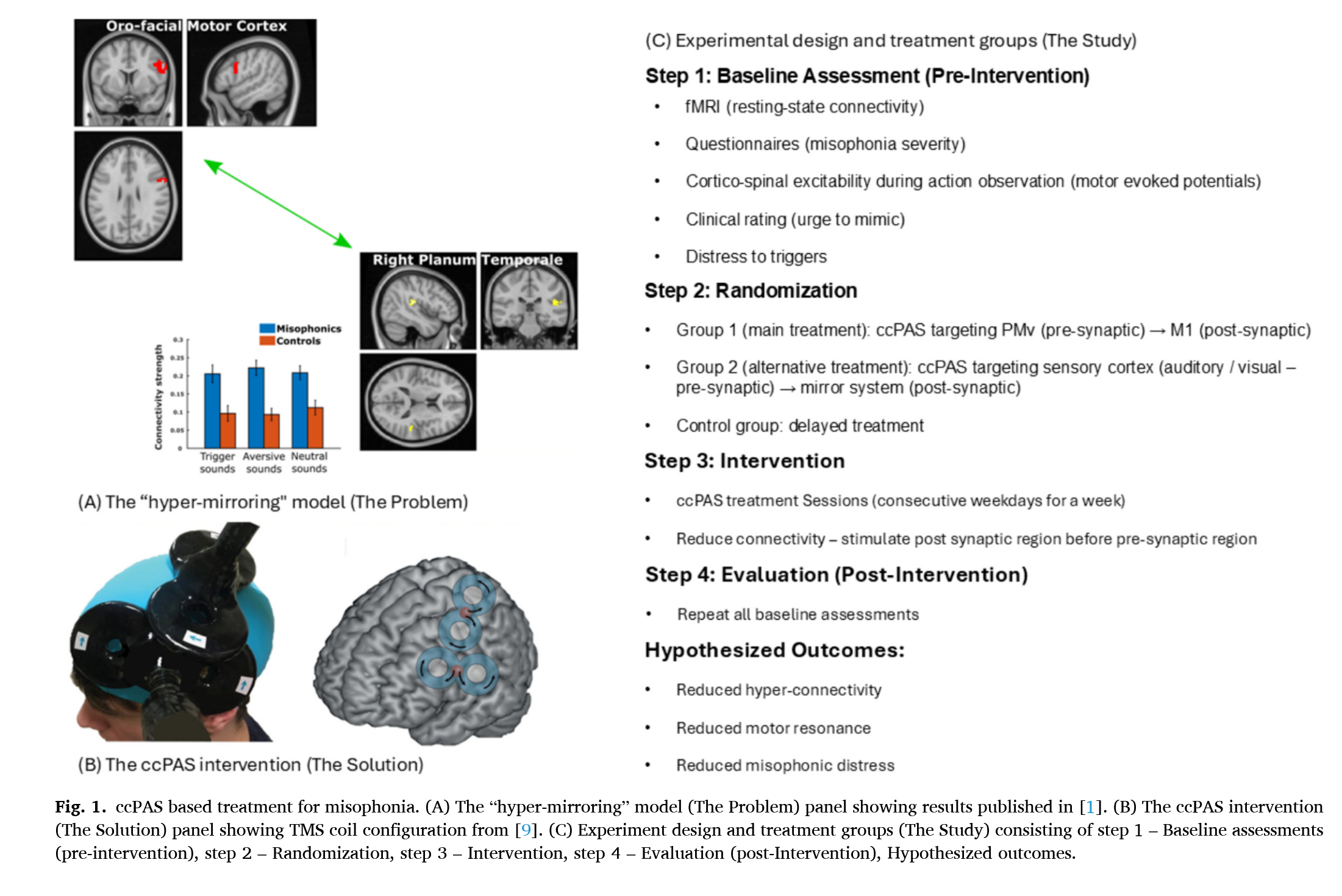
| Background/Purpose | Background- • Misophonia lacks an effective evidence-based treatment and has been linked to abnormal brain responses, especially hyperactivation in motor areas in response to trigger sounds. • Previous studies show increased connectivity between orofacial motor cortex and auditory/visual cortices during misophonic trigger exposure, supporting a model of hyper mirroring. • rTMS studies have demonstrated modest success in reducing distress by targeting prefrontal areas to indirectly downregulate anterior insula activity. • ccPAS, a technique used to reduce automatic imitation in healthy individuals, offers a new network-targeted intervention to directly modulate the mirror neuron system. Purpose- • Propose ccPAS as a novel treatment approach for misophonia aimed at reducing motor hyper-responsivity and mirroring. • Test two ccPAS protocols: (1) reducing PMv–M1 connectivity, and (2) reducing connectivity between sensory cortices and motor cortex based on individual sensory triggers. • Evaluate whether these approaches can reduce motor resonance and associated distress. • hypothesis to be tested in the future- Administration of a ccPAS protocol consisting of activating the post-synaptic area (M1) before the pre-synaptic orofacial motor cortex (PMv) is expected to reduce the hyperactivity previously observed in these regions in individuals with misophonia, thereby reducing misophonic distress. (page 3) |
| Participants/samples | • No demographic details provided; ethics approval to be obtained pre-data collection. |
| Measures | gives the following operational definitions : • Neuroimaging Index – Resting-state fMRI to assess PMv-M1 and sensory-motor connectivity pre/post intervention. • Neurophysiological Index – Corticospinal excitability assessed via single-pulse TMS and motor-evoked potentials (MEPs) during action observation. • Clinical Index – Self-reported urge to mimic trigger sounds, misophonia severity questionnaires, and distress ratings during trigger paradigms. |
| Procedures | • Stimuli – Subject-specific trigger sounds (e.g., chewing) during stimulation to potentially enhance specificity of neuromodulatory effects. • Experimental Design (see diagram on page 2): • Step 1: Baseline assessment (fMRI, questionnaires, MEPs, trigger exposure). • Step 2: Randomization into: • Group 1: ccPAS targeting PMv → M1. • Group 2: ccPAS targeting sensory cortex → motor cortex (tailored to dominant modality). • Control group: delayed treatment. • Step 3: Intervention with ccPAS (weekday sessions). • Step 4: Post-intervention evaluation. |
| Results | N/A |
| Discussion/Limits | Conclusion- • Authors propose that ccPAS can reduce pathological mirroring by weakening connectivity within the mirror neuron network, particularly between PMv and M1. • Predict reduced misophonia-related distress and motor resonance following ccPAS. |
| Limitations:: | • Theoretical model; human data collection has not yet begun. • Efficacy may depend on trigger specificity; ccPAS paired with stimulus exposure may be required. • Misophonia may involve multimodal triggers; treatment may need tailoring per individual. |
| Future Directions:: | • Refine ccPAS protocols for enhanced efficacy, potentially by integrating trigger-specific stimulation. • Compare effects of motor-motor vs. sensory-motor targeted ccPAS. • Extend findings to broader misophonia phenotypes and diverse populations. |
| Relevance:: | • a medical hypothesis article ( co authored by Kumar) that builds on a previous article (Dheerendra & Ramesh, 2025) that proposed dysregulation in iron in the mirror system as underlying the cause of Misophonia (though they do not go over the iron thing in this article) • an interesting hypothesis article both for its addition to the Kumar model ( i.e. the iron thing) but also due to the proposed TMS approach they describe. |
Notes
key terms
-
Misophonia – A condition characterized by intense emotional and physiological distress in response to specific trigger sounds, often orofacial human-generated sounds (e.g., chewing).
-
Hyper mirroring – A proposed mechanism in misophonia involving excessive and involuntary activation of the observer’s motor system in response to others’ actions, leading to over-identification or mimicry.
-
Mirror neuron system – Brain network that activates both during execution and observation of actions; implicated in empathy, mimicry, and potentially hyper-responsivity in misophonia.
-
ccPAS (cortico-cortical Paired Associative Stimulation) – A TMS-based neuromodulation technique that manipulates connectivity between cortical areas through timed pulses based on Hebbian spike-timing-dependent plasticity.
-
PMv (ventral premotor cortex) – A cortical area involved in action observation and planning; one of the key nodes proposed for stimulation in ccPAS.
-
M1 (primary motor cortex) – Target region for modulating motor resonance through ccPAS; involved in execution of motor commands.
-
Motor resonance – Automatic activation of the motor system during observation of others’ actions; operationalized via fMRI, motor-evoked potentials (MEPs), and self-reports.
-
Hebbian theory- defined as a principle of synaptic plasticity proposing that neuronal connections are strengthened through repeated and persistent activation of one neuron by another, leading to increased efficiency in their communication. source (page 2)
my engagement notes
my questions
my comments
Bookmarks
reading notes
Treatment Implications
-
ccPAS is well tolerated, non-invasive, and practical for clinical use (10–30 min sessions over 5 days).
-
May provide a targeted, neuromodulatory intervention distinct from cognitive-behavioral approaches.
Theoretical Significance
-
Supports a motor mirroring-based model of misophonia over alternative affective processing theories.
-
Reinforces the role of the mirror neuron system in social cognition and misophonic distress.
Experimental Innovation
-
Integrates multiple measurement modalities (fMRI, TMS, self-report) to operationalize motor resonance.
-
Proposes individualized, trigger-specific neuromodulation protocols.
Funding Acknowledgement
- Supported by Misophonia Research Fund and Biotechnology and Biological Sciences Research Council.