Properties (12)
- purpleRed
- (Savard & Coffey, 2025)
•
Toward cognitive models of misophonia
Status:: #status/reviewed
Metadata
- Item Type: #journalArticle
- Authors: Marie-Anick Savard, Emily B.J. Coffey,
- Date:
- Date Added: 1737610426000
- URL: https://linkinghub.elsevier.com/retrieve/pii/S0378595525000036
- DOI: 10.1016/j.heares.2025.109184
- Cite Key: savardCognitiveModelsMisophonia2025
- Topics: [object Object]
- Tags: #to-review, #Misophonia, #Highlighted-source, #seminal-work, #literature-review, #needs-deep-dive, #in-review,
- PDF Attachments
Abstract
| Background/Purpose | Background-N/A Purpose- a review on the topic of Misophonia in the context of cognitive models |
| Participants/samples | N/A |
| Measures | N/A |
| Procedures | Lit reivew |
| Results | N/A |
| Discussion/Limits | N/A |
| Limitations:: | N/A |
| Future Directions:: | The paper identifies several challenges and outlines potential next steps for misophonia research: • Addressing methodological limitations: The need for larger sample sizes, standardized diagnostic criteria, and careful consideration of comorbidities in research studies. • Developing more comprehensive models: Integrating findings from multiple domains (behavioral, cognitive, neuroanatomical, neurophysiological) to create models that account for the complexity and variability of misophonia. • Investigating potential subtypes of misophonia: Exploring whether different subtypes exist based on the involvement of different auditory processing streams or cognitive networks. • Differentiating misophonia from related disorders: Clarifying the relationship between misophonia, misokinesia, and other sensory sensitivities. • Understanding the neural relationship between positive and negative emotional responses to sounds: Investigate why some people experience both misophonia and strong emotional responses to music. (page 11) |
| Relevance:: | • a fantastic review of the literature on Misophonia and is especially helpful for looking at it from a cognitive perspective. it also does a fantastic job of summarizing the neurological models and giving a general overview of all the major topics in Misophonia research • good source for future directions and outstanding research questions |
Notes
my engagement notes
Bookmarks
- bookmark for talking about measuring misophonia (page 4)
- bookmark to giving an overview of misophonia phenomonology (page 5)
- bookmark for talking about Auditory and cognitively-based coping mechanisms (page 6)
- bookmark for talking about the The role of context and sound meaning in misophonia (page 6)
- bookmark talking about cognitive differences in Misophonics in the absence of triggers (page 7)
- bookmark talking about cognitive differences in Misophonics in the the presence of triggers of triggers (page 7)
- bookmark describing history of studying the neuroanatomy of Misophonia (page 7)
- bookmark talking about the existing Misophonia models (page 9)
- bookmark talking about Misophonia in the broader auditory network (page 10)
- bookmark for talking about Misophonia and the involvement of higher level networks (page 10)
- research questions for the future (page 11)
reading notes
cognitive basis of Misophonia
Misophonia is closely linked to higher-level cognitive processes rather than being predominantly sensory in nature1 . The cognitive context of sound processing significantly influences emotional reactivity, with the brain's interpretation and identification of sounds within specific contexts playing a crucial role1 .... The acoustic patterns of misophonic sounds and the resulting emotional responses vary significantly among individuals, suggesting that personal history, learning, and context play crucial roles in shaping aversive reactions3 .
Relevant cognitive influences include:
-
Sound Meaning and Context- The actual context of a sound and the way it is cognitively processed can alter the intensity of the misophonic reaction4 . Misophonic responses can be triggered by visual stimuli that are associated with triggering sounds5 . Even imagining a trigger sound can provoke the same aversive reaction as hearing the actual sound, further suggesting that history with the sound is more important than acoustic properties5 .
-
Attention; Misophonic reactions often include hyperfixation on the triggering sound6 . Studies show that misophonic responses negatively affect cognitive control7 .
-
Executive Functions- Coping strategies rely on executive functions, a set of cognitive processes that support goal-directed behavior8 .
-
Perceptual Decision- Making Misophonia is intertwined with cognitive processes, including perceptual decision-making, attentional control, response inhibition, and perceptual alertness9 .
-
Emotional Regulation- Difficulties in regulating emotions may occur10 .
-
Memory-:Heightened salience network activation may lead to exaggerated responses to trigger sounds, affecting emotional and attentional processes, and increased coupling between the anterior insula and default mode network may impair default mode network deactivation, allowing memories and contextual associations to intensify the misophonic response11 . (page )
-
studies showing some improved cog abilities in miso. suggesting possible midigation of symnptoms through training-based approaches. (page 7)
-
Neuroanatomical and Neurophysiological Findings:
-
The paper reviews structural and functional neuroimaging studies, highlighting brain regions implicated in misophonia, including the anterior insular cortex (AIC), amygdala, superior temporal gyrus (STG), and ventromedial prefrontal cortex (vmPFC). "Individuals with misophonia also show greater activity in the anterior insular cortex when listening to sounds, a region which is thought to play a role in subjective emotional experience...". It notes that findings are somewhat inconsistent, possibly due to small sample sizes, variations in diagnostic criteria, and comorbidities. (page 7)
Existing models of Misophonia
The authors note that the three models aren’t mutually exclusive, though they emphasize different aspects of cognition, neuropathophysiology, and etiology, and differ in how neural structures are delineated . The authors state that while parsimonious models are desirable, each of these does not account for the full range of phenomenological, behavioral, and cognitive observations . (page 9)
Jastreboff and Jastreboff (2023)
This model emphasizes the differences between misophonia and hyperacusis and focuses on developing treatments2 . In misophonia, the auditory system functions normally, but abnormal connectivity stimulates the limbic and autonomic nervous system . These abnormal connections are driven by complex conditioned stimuli; where elements like personal relationships and controllability account for the overrepresentation of orofacially-generated sounds and greater reactions to sounds produced by family members.
Aryal and Prabhu (2023)
This neuroaudiological model proposes that auditory processing is normal from the auditory periphery through to the subcortical areas . However, non-classical pathways from subcortical structures to the limbic system and autonomic nervous system are stronger or hyperactive in people with misophonia, leading to emotional and physical responses . Impaired sensory gating leads to abnormal neural activity of the auditory cortex and association areas, increasing negative associations of triggers and emotions via classical conditioning
Berger et al. (2024)
This model centers around social cognition, positing that misophonic distress arises from the interplay between auditory perception and motor representation . In misophonia, the brain generates motor representations of sounds, which typically occurs during normal sound processing . Heightened connectivity between auditory and motor regions, influenced by the auditory stimulus context, leads to an aberrant signal being forwarded to the insula . From there, abnormal information passes to the amygdala and autonomic nervous system, generating high emotional and physiological responses5 . The model allows for bidirectional processes, with a feed-forward pathway from the auditory system to the limbic system and predictive coding mechanisms that intensify the emotional impact of trigger sounds .
Importance of considering the broader auditory network:
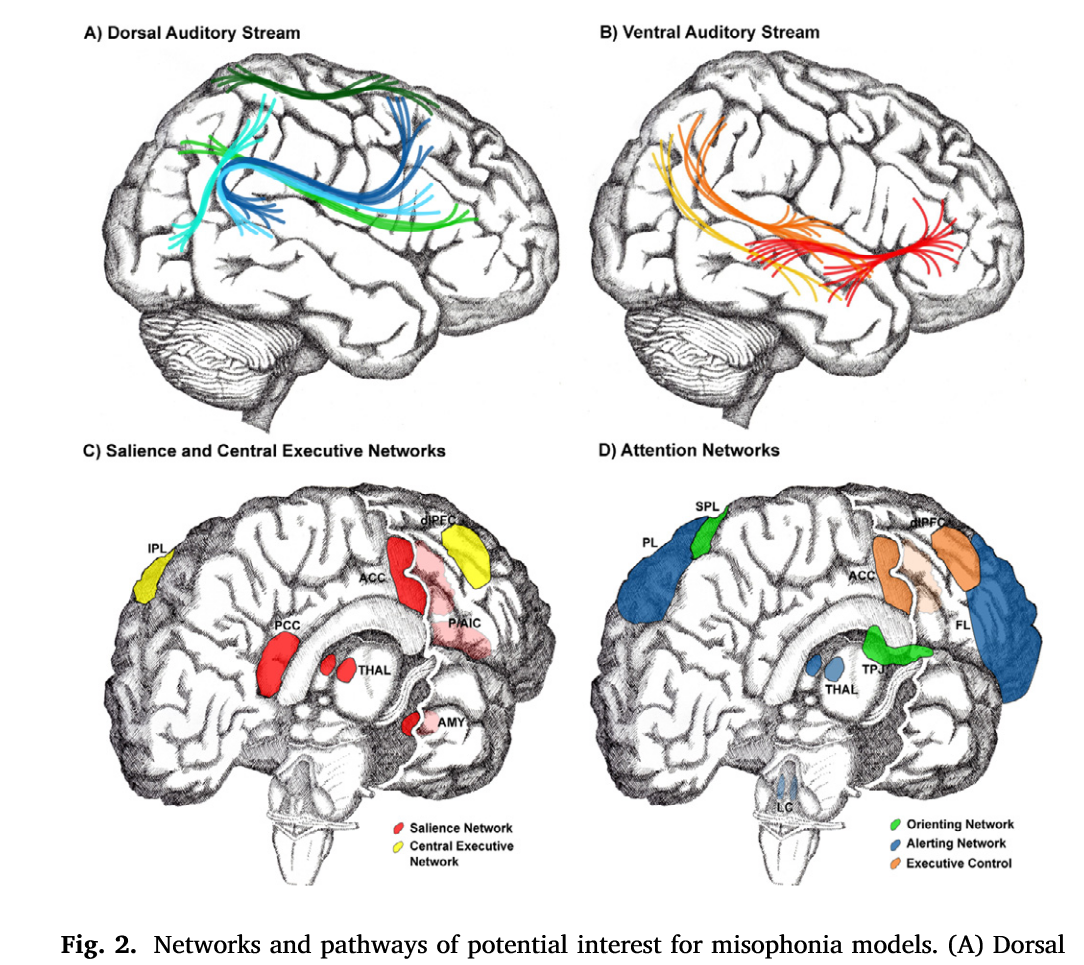
While lower-level auditory processing is generally considered normal in people with misophonia, the authors emphasize that the auditory system does not function in isolation. Increasingly complex and abstract sound representations are produced at progressively higher levels, combined with information from other sensory modalities, used by and influenced by other cognitive systems... The dorsal (sensorimotor integration) and ventral (sound categorization and meaning) auditory processing streams are likely both involved. (page 10)
Involvement of Higher-Level Networks:
The paper discusses the potential involvement of the salience network (SN), default mode network (DMN), and central executive network (CEN) in misophonia. In misophonia, heightened SN activation — especially in the AI — may lead to exaggerated responses to trigger sounds, affecting emotional and attentional processes . It also addresses the role of attention networks (alerting, orienting, and executive control) and how impairments/enhancements in these networks may contribute to misophonia.
- Need for comprehensive models: The authors argue that future models need to consider multiple cognitive functions and widespread brain networks, ;We thus expect comprehensive models of misophonia to include multiple cognitive functions and widespread brain networks; They highlight the need for more research using larger, well-controlled samples and open science practices.
The authors propose that the roles of higher-level networks are not explicit in existing models of misophonia1 . They summarize several networks that could be involved in misophonia for consideration in future models1 .
These networks include the salience network (SN), default mode network (DMN), central executive network (CEN), and attention networks2 ....
Salience Network (SN)
The SN plays a critical role in detecting and filtering significant stimuli based on cognitive, homeostatic, or emotional factors2 . The anterior insula within the SN facilitates bottom-up detection of salient events and manages transitions between networks essential for attention and working memory2 . It monitors internal and external environments, regulating autonomic responses with the posterior insula2 . Strong connectivity with the anterior cingulate cortex (ACC) enables quick reactions to salient stimuli, while the ACC integrates cognitive and emotional information, guiding behavior and supporting decision-making via the prefrontal cortex2 . The SN coordinates transitions between networks, activating the CEN while deactivating the DMN to engage different cognitive processes4 . In misophonia, heightened SN activation may lead to exaggerated responses to trigger sounds, affecting emotional and attentional processes5 . Increased coupling between the anterior insula and DMN may impair DMN deactivation, allowing memories and contextual associations to intensify the misophonic response5 .
Central Executive Network (CEN)
The CEN comprises the dorsolateral prefrontal cortex and parietal regions and is crucial for higher cognitive functions like attention and decision-making, balancing demands from the dorsal attention system and the hippocampal-cortical memory system4 .
Default Mode Network (DMN)
The DMN is active during rest and introspection and supports self-referential thought and memory retrieval4 . It deactivates during goal-directed tasks to maintain a baseline state of awareness that facilitates processing of stimuli6 . The balance between the SN and DMN is critical for cognitive control, and failures to deactivate the DMN during external attention tasks are linked to attention lapses6 .
Attention Networks
The Attention Network Theory identifies three interacting attention networks: alerting, orienting, and executive control3 .
-
The alerting network, linked to the norepinephrine system, activates the thalamus, frontal cortex, and parietal cortex to increase sensitivity to stimuli7 .
-
The orienting network is responsible for selecting and aligning attention with sensory inputs, automatically and voluntarily7 . Key regions include the superior parietal lobe and the temporal parietal junction8 .
-
The executive control network monitors and resolves conflicts among thoughts and responses, mainly involving the ACC8 . Ventral areas of the ACC are closely involved with emotional regulation, while dorsal areas are more involved in purely cognitive tasks8 . Behavioral impairments in the alerting network indicate difficulties in maintaining focus and readiness, which may contribute to heightened emotional responses to aversive stimuli9 . Enhancements in the orienting network suggest a selective attentional bias toward threatening sounds9 . (page 10)
Challenges and Next Steps
The paper identifies several challenges and outlines potential next steps for misophonia research:
- Addressing methodological limitations: The need for larger sample sizes, standardized diagnostic criteria, and careful consideration of comorbidities in research studies.
- Developing more comprehensive models: Integrating findings from multiple domains (behavioral, cognitive, neuroanatomical, neurophysiological) to create models that account for the complexity and variability of misophonia.
- Investigating potential subtypes of misophonia: Exploring whether different subtypes exist based on the involvement of different auditory processing streams or cognitive networks.
- Differentiating misophonia from related disorders: Clarifying the relationship between misophonia, misokinesia, and other sensory sensitivities.
- Understanding the neural relationship between positive and negative emotional responses to sounds: Investigate why some people experience both misophonia and strong emotional responses to music. (page 11)
Zettelkasten
Misophonia involves higher order cognitive process more then simple sensory system issues
Savard and Coffey recap of three models of misophonia
Savard and Coffey 2025 call for looking into Misophonia subtypes