Properties (17)
- purpleRed
- “How Can I Get Out of This?
- (Guzick et al., 2024)
•
“How Can I Get Out of This?”: A Qualitative Study of the Phenomenology and Functional Impact of Misophonia in Youth and Families
Status:: #status/Bare-bones-review
Metadata
- Item Type: #journalArticle
- Authors:: Andrew Giles Guzick, Catherine Elizabeth Rast, Brenna Burns Maddox, Servando Rodriguez Barajas, Jane Clinger, Joseph McGuire, Eric A. Storch,
- Date:
- Date Added: 1729478192000
- URL: https://karger.com/doi/10.1159/000535044
- DOI: 10.1159/000535044
- Cite Key: guzickHowCanGet2024
- Topics: [object Object]
- Tags:: #Misophonia, #Bare-bones-review-🦴, #sensory-over-responsiveness, #Phenomenology, #CBT,
- PDF Attachments
Abstract
| Background/Purpose | Background- • Misophonia involves strong negative emotional reactions to specific sounds and visual cues. • Triggers most often involve human-produced oral sounds. • Misophonia associated with quality of life impairments and co-occurring psychopathology. • Onset most often in childhood; minimal research on youth presentation. • Adult phenomenology characterized via S-Five, DMQ, SMS scales. • Common adult emotional reactions: anger, annoyance, irritation, disgust, anticipatory anxiety. • Prior CBT models emphasize need for control, perfectionism, avoidant coping, hyperfocus, associative learning, emotion regulation difficulties. • One adult RCT showed an 8 week group based CBT protocol was superior to a waitlist control. • Most prior research used adults, psychometric methods, or case studies. • Qualitative methods suited to early-stage phenomenology research. Purpose- • Use qualitative methods to investigate clinical presentation and functional impairment of misophonia in youth. • Apply a family-based cognitive behavioral perspective focused on thoughts, behaviors, and subjective physiological experiences. |
| Participants/samples | • 20 youth-parent dyads recruited via internet, prior study contacts, professionals. • Youth ages 10–17, mean 13.45. • 80% female youth; 100% white; predominantly high SES. • Inclusion: misophonia diagnosis via Misophonia Assessment Interview updated with Delphi consensus criteria; ages 10–20; English-speaking; US-based. • Exclusion: inability to participate in open-ended interview; active psychosis or suicidal ideation. - |
| Measures | • Misophonia Assessment Interview (MAI) for diagnosis and trigger/avoidance/interference characterization. • Demographics survey. • Semi-structured focused interview developed by investigative team. |
| Procedures | • Prescreening call for eligibility. • Virtual visit with informed consent, MAI administration, demographics, focused interview. • Parents and children interviewed separately. • Interviews 30–60 minutes; recorded and transcribed. • Thematic analysis: transcription, code generation, theme search, theme review, defining/naming, reporting. • Coding via MAXQDA with cognitive behavioral framework. • Double-coding by first two authors; modified system until ≥80% overlap; 20% of remaining transcripts double-coded with 82% agreement. • Memos shared with investigators and participating families for feedback. |
| Results | Trigger characteristics • Most common triggers: breathing/sniffing/yawning; eating/chewing; tapping; throat clearing. • Most common emotional response: anger; followed by annoyance/irritation, distress, disgust. • Most common reactive behaviors: loss of self-control, yelling/hurtful speech. • Sounds upsetting most often due to nature of sound (95%) and specific pattern (80%). Cognitive behavioral processes around triggers • Active and preparatory avoidance common, especially headphone use and situational withdrawal. • Anticipatory anxiety described in anticipation of emotional reaction and consequences of aggressive responses. • Hypervigilance and lack of attentional control once triggered; difficulty disengaging. • Family accommodations widespread: trigger avoidance, announcement before triggers, background noise, item changes, plan modifications. • Strong automatic emotional reactions with "fight or flight" sensation; difficulty articulating thoughts during episodes. • Tension behavioral and subjective; sometimes sustained post-trigger. • Urge to escape often near-automatic and defensive. • Automatic negative attributions about others, often with awareness of irrationality. • Coping via redirecting attention and relaxation strategies less frequent than avoidance/escape. • Aggression most often verbal, directed at parents and siblings; sometimes physical/property damage; followed by guilt/regret. Daily individual impacts • Negative perception of self including shame and guilt. • Negative outlook of future including hopelessness and catastrophizing. • Somatic symptoms attributed to muscle tension (headaches, stomachaches). • Secondary anxiety, depression, emotional exhaustion. • High emotional burden during school day with exhaustion upon returning home. • School accommodations or homeschooling common; accommodations helpful but linked to missing social/learning components. • Concentration difficulties at school without reported academic decline liekly due to sample specific availability of accommodations and homeschooling/veritual schooling . Interpersonal impacts • Family conflict and tension with "walking on eggshells" experience. • Increased arguments; aggression more pronounced toward family than others. • Reduced family time; chosen avoidance to prevent reactions. • Family anger and resentment moderated by understanding and reaction severity. • Bullying, victimization, and lack of understanding at school in some cases. • Stress in social situations including altered perceptions of others. • Social withdrawal from people and leisure activities. |
| Discussion/Limits | Conclusion- • Misophonia in youth is an emotionally exhausting syndrome affecting entire family systems. • Families showed congruence in overwhelming emotional reactions, fight/flight urges, escape behavior, family tension, and attentional disengagement difficulties. • Misophonia produces significant mental health and functional impairment across family, social, and academic domains. • Childhood misophonia uniquely implicates parent and sibling roles, family accommodation, and the school context. • Candidate CBT targets include distress tolerance for emotional/physiological reactivity, mindfulness for attentional control, acceptance/reframing for maladaptive cognitions, gradual exposure for avoidance/escape, and supportive communication for parent-child conflict. • Family factors should be incorporated into misophonia assessment and family-based therapy. • Formal school accommodations mitigate functional impairment in the school setting.. |
| Limitations:: | • Predominantly white, female, high-SES, educated sample. • Self-selected primarily from online misophonia forums. • Limited family structure diversity. • No data from other family members (siblings, grandparents). • Age range broad without developmental analysis. |
| Future Directions:: | • Recruit community samples for diversification and generalization. • Include diverse family structures. • Solicit data from siblings and other relatives. • Investigate developmental changes across ages. • Further analysis of treatment and diagnosis experiences and family priorities. • CBT development for childhood misophonia should prioritize modular or process-based frameworks over multicomponent packages, which risk diluting central techniques. |
| Relevance:: | • a phenomenological study looking at the impact of Misophonia on individual function and family dynamics. • a good source for looking at the familial impacts and lived experiences of Misophonia • describes a cognitive behavioral trigger cycle |
Notes
key terms and concepts
-
misophonia – disorder characterized by strong negative emotional reactions to specific sounds and visual cues.
-
trigger – specific sound or visual cue that evokes a misophonic reaction; most often human-produced oral sounds.
-
family accommodation – modifications household members make to minimize impact of misophonia-related reactions.
-
preparatory avoidance – avoiding situations where triggers are expected.
-
active avoidance/distraction – measures taken when encountering triggers, most commonly using headphones.
-
automatic negative attributions – near-automatic hostile interpretations of others (e.g., believing others make noises on purpose).
-
thematic analysis – qualitative coding approach following Braun & Clarke's six-phase framework.
my engagement notes
my questions
my comments
Bookmarks
reading notes
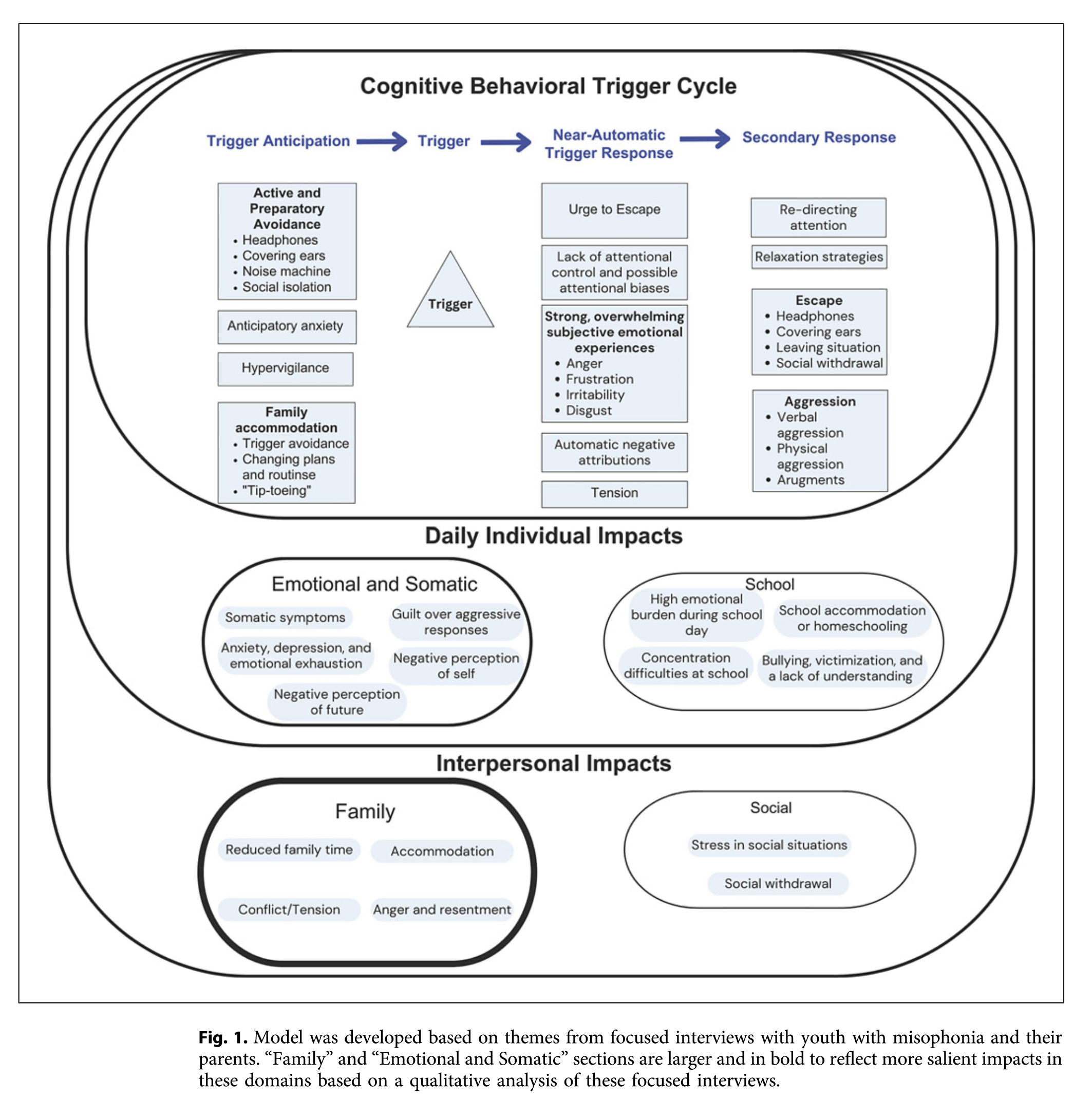
Proposed conceptual model (Figure 1)
- Cognitive Behavioral Trigger Cycle: Trigger Anticipation → Trigger → Near-Automatic Trigger Response → Secondary Response.
- Anticipation phase: active/preparatory avoidance, anticipatory anxiety, hypervigilance, family accommodation.
- Near-automatic phase: urge to escape, attentional control loss, overwhelming emotional experience, automatic negative attributions, tension.
- Secondary response phase: redirecting attention, relaxation, escape, aggression.
- Daily Individual Impacts encompass Emotional/Somatic and School domains.
- Interpersonal Impacts encompass Family and Social domains.
- Family and Emotional/Somatic depicted as most salient.
contextual statement
In a 2024 study, Guzick attempted to characterize the phenomenology and functional impact of misophonia in youth from a cognitive behavioral perspective by conducting semi-structured focused interviews with 20 youth (ages 10–17) with misophonia and their parents, using thematic analysis of MAI-confirmed cases.