Properties (15)
Id 5250b58a-ff8d-47e8-9566-01e3de27fbdb
Year 2025
Abstract Tinnitus patients frequently complain about Decreased Sound Tolerance (DST) as well. Based on the observations of several hundred patients with Decreased Sound Tolerance the existence of unrecognized earlier auditory disorder with distinctive and different from hyperacusis characteristics has been identified. Patients with this disorder exhibited negative emotional and autonomic reactions evoked by a specific for a given patient patterns of sound. Consequently, the name misophonia for this previously not described disorder and its definition based on data gathered from our patients was proposed in 2001. It is possible to have tinnitus, hyperacusis, and misophonia in combination or as isolated conditions.
Cssclasses
- purpleRed
Aliases
- (Jastreboff & Jastreboff, 2025)
Import Date 04-13-2026
Template Version Notes •corrected error in rendering the linked PDF in metadata section • added the tag “noted” to the definition of comments to ignore ( like with the “in another note” tag. this is so that when making notes on chapters of a textbook, i can still export things for manual addition to the obsidian note without having to keep track of what has already been added ). Also moved the version notes to the yaml section • this version added the bookmarks section to auto collect all bookmarks. it also dropped the template auto fill of the initial source field because we never got it working and just overwrote it manually anyway. this version also added logic to handle “in another note” tag. annotations marked with this are completely ignored. used when i have information covered in a bigger note, but still want to highlight that part in text for visual clarity (so as to avoid duplicates of the same information) • running the import more then once will overwrite the file, so do not import again if you have made changes in obsidian that are not in the zotero article.
Dv Authors Pawel J. Jastreboff, Margaret M. Jastreboff,
Dv Initial Source Misophonia MOC
Dv Status #status/reviewed
Dv Limitations • Paper is explicitly a hypothesis/theoretical paper; no new empirical data are presented. • Model relies on clinical observations from a single clinical group without controlled study design. • Neuroimaging evidence cited is from external studies; authors acknowledge inconsistency in the literature without resolving it. • Treatment success rate (83%) is referenced from prior publications, not reported with new data here.
Dv Future Directions • N/A
Dv Relevance • short overview paper describing the Jastreboff model of Misophonia and hyperacusis. in fact this is basically a TLDR of jastreboffNeurophysiologicalApproachMisophonia2023\(Jastreboff & Jastreboff, 2023), as they basically as much right at the end of the paper • a good quick reference for the Jastreboff model
Zotero Note Link Generated true
Checked For Zettle Notes true
•
The Neurophysiological Model for Hyperacusis and Misophonia
Status:: #status/reviewed
Metadata
- Item Type: #journalArticle
- Authors:: Pawel J. Jastreboff, Margaret M. Jastreboff,
- Date:
- Date Added: 1769137616000
- URL: https://www.journalofhearingscience.com/THE-NEUROPHYSIOLOGICAL-MODEL-FOR-HYPERACUSIS-AND-MISOPHONIA,211238,0,2.html
- DOI: 10.17430/jhs/211238
- Cite Key: jastreboffNeurophysiologicalModelHyperacusis2025
- Topics: [object Object]
- Tags:: #reviewed, #Misophonia, #seminal-work, #tinnitus, #Hyperacusis, #hypothesis-paper, #The-Neurophysiological-Model-of-Tinnitus-and-Decreased-Sound-Tolerance, #DST,
- PDF Attachments
Abstract
| Background/Purpose | Background- • DST is a syndrome listed across many medical conditions including acoustic trauma, migraines, Williams syndrome, Lyme disease, and autism. • Historically, "hyperacusis" and "phonophobia" were used interchangeably to describe abnormal sound reactions, without careful definition, creating diagnostic confusion. • Clinical observation of hundreds of DST patients identified a subgroup whose reactions could not be classified as hyperacusis or phonophobia. • The term "misophonia" was first proposed by the authors in 2001 to describe this previously unnamed DST subtype. • Existing neuroimaging literature on both tinnitus and misophonia has produced inconsistent findings; the only common observation across tinnitus imaging studies is limbic system involvement. • Schroeder (2013) proposed misophonia as a psychiatric disorder based on a psychiatric clinic sample; the authors explicitly dispute this classification. • Commonly used depression (PHQ-9) and anxiety (GAD-7) questionnaires do not differentiate situation-evoked from chronic psychiatric disorders, leading to misclassification of misophonia comorbidities. Purpose- • Overall goal: to expand and clarify the neurophysiological model of hyperacusis and misophonia, stressing aspects insufficiently addressed in prior publications. • Delineate mechanistic distinctions between hyperacusis and misophonia and articulate their differential treatment implications. • Address the misclassification of misophonia as a mental disorder. • Provide guidance on accommodation management and social/environmental factors in misophonia. |
| Participants/samples | • N/A |
| Measures | • N/A |
| Procedures | review/hypothesis paper |
| Results | • N/A |
| Discussion/Limits | Conclusion- • Misophonia results from conditioned reflexes linking auditory input with limbic and autonomic systems. • Hyperacusis is driven by increased auditory pathway gain rather than abnormal cross-system connections. • The auditory system plays a secondary role; limbic and autonomic systems are dominant in clinically significant cases. • The data support that misophonia is not a mental disorder but a neurophysiological conditioned response. • Tinnitus and misophonia share mechanisms except for sound origin. • Similar behavioral reactions across DST conditions mask distinct underlying mechanisms. • Misophonia can develop without any structural brain dysfunction. • Treatment must differ between hyperacusis and misophonia. |
| Limitations:: | • Paper is explicitly a hypothesis/theoretical paper; no new empirical data are presented. • Model relies on clinical observations from a single clinical group without controlled study design. • Neuroimaging evidence cited is from external studies; authors acknowledge inconsistency in the literature without resolving it. • Treatment success rate (83%) is referenced from prior publications, not reported with new data here. |
| Future Directions:: | • N/A |
| Relevance:: | • short overview paper describing the Jastreboff model of Misophonia and hyperacusis. in fact this is basically a TLDR of (Jastreboff & Jastreboff, 2023), as they basically as much right at the end of the paper • a good quick reference for the Jastreboff model |
Notes
key terms and concepts
- Decreased Sound Tolerance (DST) – condition present when a person exhibits negative reactions following exposure to sound that would not evoke the same response in an average listener.
- Hyperacusis – condition in which negative reactions to sound depend only on its physical characteristics (spectrum, intensity); reflects abnormally strong reactivity (abnormally high gain) of the auditory pathways to sound, which in turn yields activation of the limbic and autonomic nervous systems.
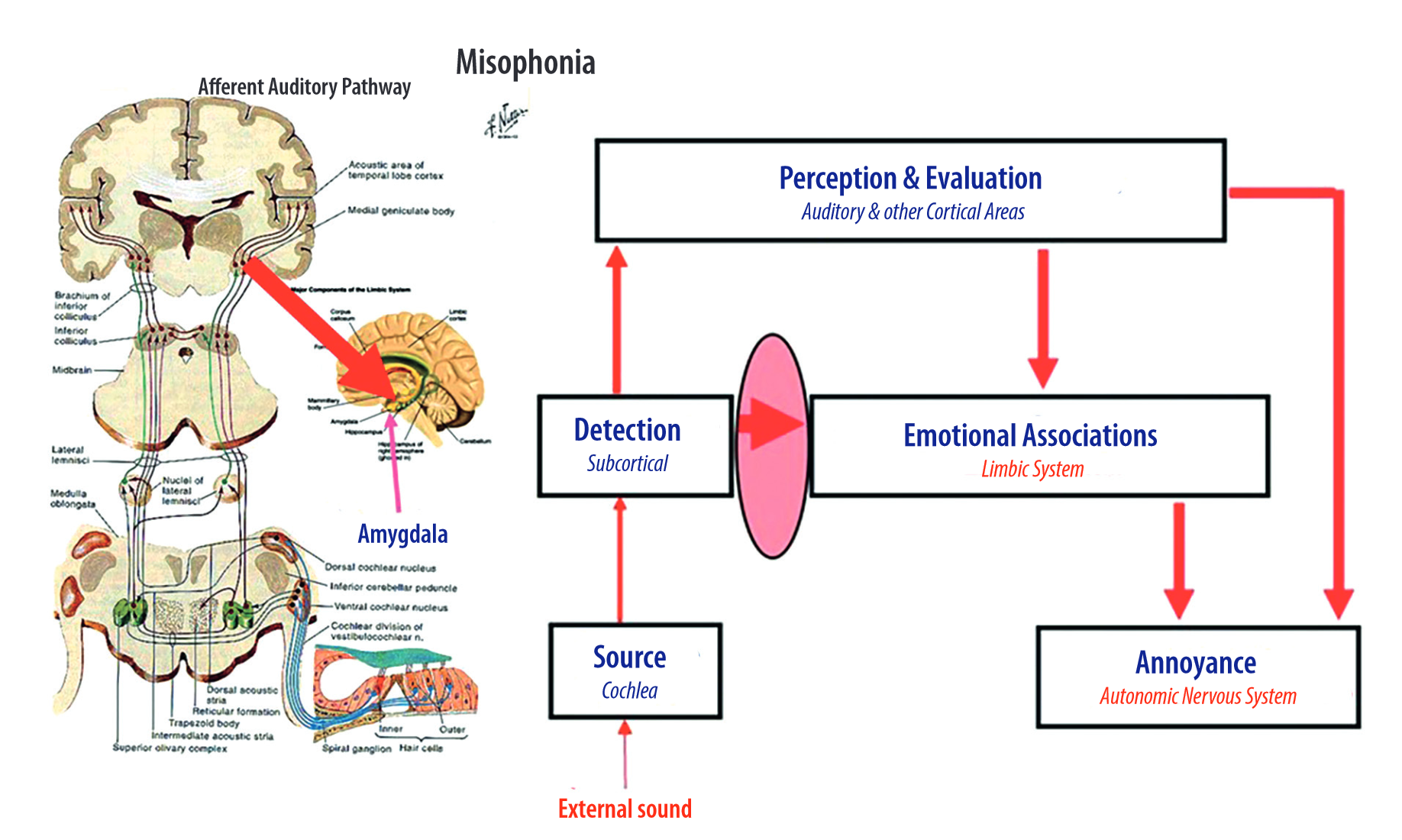
- Misophonia – condition in which negative reactions occur to sounds with specific patterns and/or meaning to a given patient; reflects abnormally strong reactions of the autonomic and limbic systems resulting from enhanced functional connections between the auditory, limbic, and autonomic systems for specific-to-patient patterns of sound.
- Conditioned reflex – subconscious, pattern-specific association formed between a sensory stimulus and a negative emotional/physiological response, governing the mechanism of misophonia.
- Tinnitus Retraining Therapy (TRT) – treatment approach derived from the neurophysiological model, applied to tinnitus, hyperacusis, and misophonia, with distinct protocols for each condition.
- Stimuli generalization – process by which secondary conditioned reflexes form to non-auditory stimuli (e.g., visual, olfactory) associated with a primary misophonic trigger.
- Situational-evoked (reactive) depression/anxiety – depression or anxiety arising as a consequence of a specific condition (e.g., misophonia), distinguished from chronic/generalized psychiatric disorders; relevant to correct ICD coding.
my engagement notes
my questions
my comments
Bookmarks
reading notes
contextual statement
In a 2025 hypothesis paper, Jastreboff and Jastreboff attempted to expand and clarify the neurophysiological model distinguishing hyperacusis from misophonia by synthesizing clinical observations from several hundred DST patients with general neuroscience principles, using mechanism-based definitions, neural pathway diagrams, and ICD classification frameworks as primary conceptual tools.
zettlekasten
Jastreboffs argument against Misophonia as a mental condition