Properties (16)
- purpleRed
- (Kumar et al., 2017)
- interoception
- ventromedial prefrontal cortex (vmPFC)
- posteromedial cortex (PMC)
- anterior insular cortex (AIC)
- default mode network (DMN)
- fMRI
- MR
- GSR
- synchronization
- #Misophonia
- HR
- AIC
•
The Brain Basis for Misophonia
Status:: #status/Bare-bones-review
Metadata
- Item Type: #journalArticle
- Authors: Sukhbinder Kumar, Olana Tansley-Hancock, William Sedley, Joel S. Winston, Martina F. Callaghan, Micah Allen, Thomas E. Cope, Phillip E. Gander, Doris-Eva Bamiou, Timothy D. Griffiths,
- Date:
- Date Added: 1581801868000
- URL: https://linkinghub.elsevier.com/retrieve/pii/S0960982216315305
- DOI: 10.1016/j.cub.2016.12.048
- Cite Key: kumarBrainBasisMisophonia2017
- Topics: [object Object],[object Object],[object Object],[object Object]
- Tags: #Misophonia, #Article-review, #added-to-Misophonia-data-base, #noted, #reviewed, #Bare-bones-review-🦴, #selected,
- PDF Attachments
Article Review Table: (Kumar et al., 2017)
| Background/Purpose | Background- • the commonality of Misophonic triggers makes it impairing to daily life • little is known about the underlying neurological mechanisms of Misophonia Purpose- • assess potential neurological underpinnings of Misophonia • asses if Misophonic reactions were related to typical annoyance experience by most people in responds to commonly unpleasant things (pdf) |
| Participants/samples | • 20 Misophonic adults', 22 age/sex matched controls • inclusion crit for Misophonia status included identifying classic triggers as triggering, being able to be triggered by sounds, alone), trigger source did not need to be a family member |
| Measures | • Subjective ratings (1–4 scale): • Annoyance (both groups). • Misophonic reaction (misophonia group). • Antisocial rating (control group). • fMRI BOLD responses (block design; TR = 3.12 s). • Functional connectivity (seed-based; left/right AIC). • Whole-brain MT saturation maps (myelination). • Heart rate (HR; bpm). • Galvanic skin response (GSR; microsiemens). • Body Consciousness Questionnaire (interoceptive sensibility). |
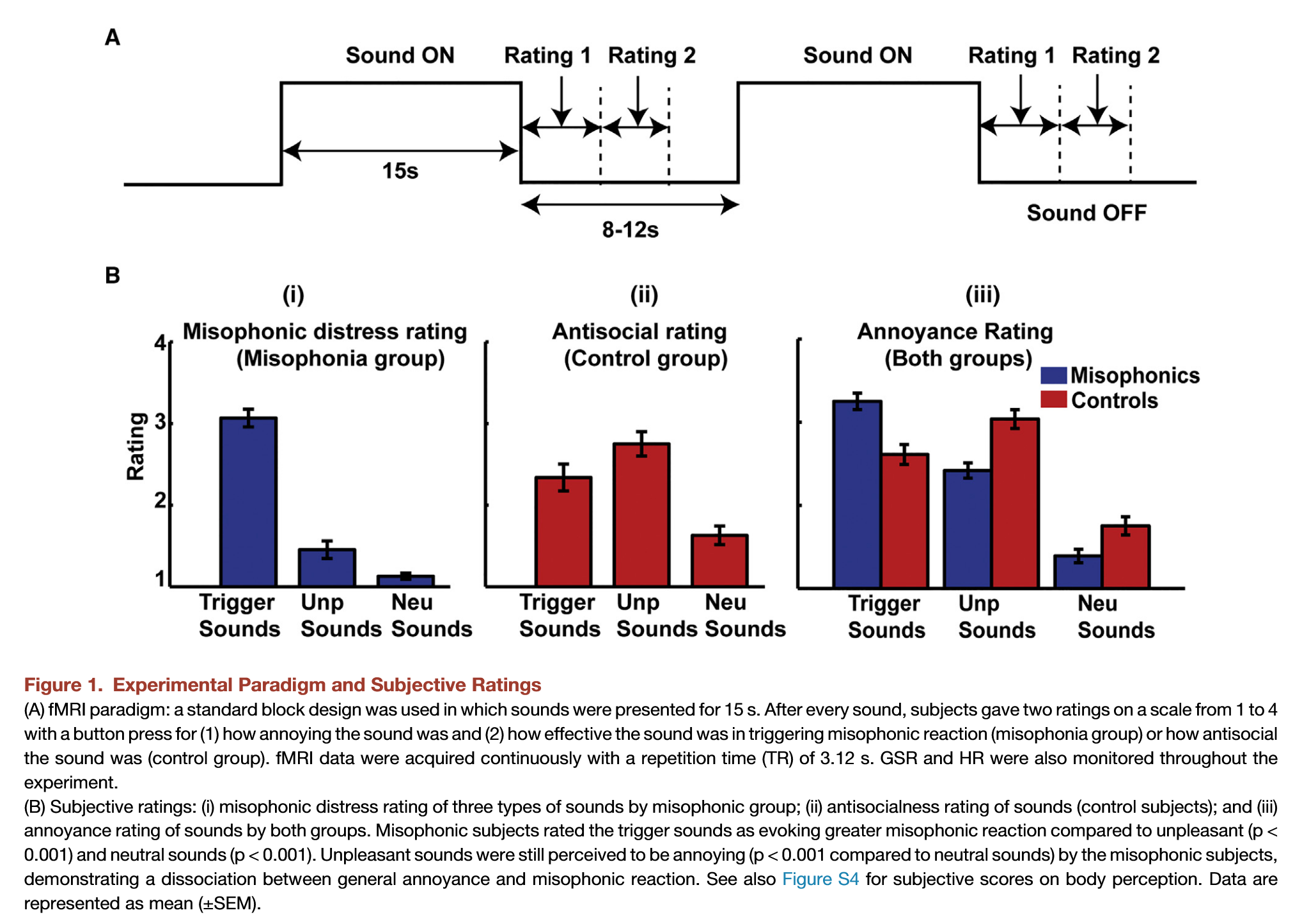
| Procedures | stimuli- 15 s clips from three categories • unpleasant sounds: sounds universally deemed unpleasant • triggers: sounds typically triggering to Misophonia (i.e. orofacial sounds) • neutral sounds: sounds deemed to be affectively neutral procedure highlights: • Block design; sounds presented for 15 s. • Sound categories: • Trigger (e.g., eating, breathing). • Unpleasant (e.g., baby cry, screaming). • Neutral (e.g., rain). • Two ratings after each sound (8–12 s interval). • Continuous fMRI acquisition. • Concurrent HR and GSR recording. • Structural MRI multi-parameter mapping. procedures- bookmark for EXP procedures in supplemental doc: (pdf) • was divided into a two day session day one: • subjects given informed consent, and completed trials. • trials started with text cueing that a sound will play soon. after a 5-7 s gap, the 15s sound played, followed by prompts to self report how annoying the sound was and how triggering the sound was ( for the control group, the second question was changed to “anti-social)” the sound was. tasks consisted of 4 blocks (126 trials each). after this they had structural MRI taken day two MR compatible electrodes and pulse oximeters were attached and subjects entered an fMRI. fMRI data collected continuously while the task from day one was repeated |
| Results | • found that Misophonics showed specific trigger related neural and bodily resposnes. this included exaggerated BOLD responses in AIC • trigger exposure was associated with abnormal functional connectivity between AIC and vmPFC , PMC, hippocampus, and amygdala in Misophonics • Misophonics self reported a different perception of their own bodies • their was no sig diff between Misophonic trigger ratings for the Misophonic group and the ratings of annoyance for the unpleasant sounds in the control group. however the authors suggest that this is a result of the two groups using different subjective scales when rating the sounds. (pdf) • Trigger sounds elicited significantly greater misophonic distress than unpleasant or neutral sounds in misophonic participants (p < 0.001), with unpleasant sounds rated as more annoying than neutral (p < 0.001), and no difference between misophonic trigger distress and control unpleasant annoyance ratings. • fMRI revealed a significant group × sound interaction in bilateral anterior insular cortex (FWE p < 0.05; peak MNI 41, 6, 0), driven by greater BOLD responses to trigger sounds in Misophonics only, with AIC activity linearly correlating with distress ratings. • Trigger sounds also produced greater AIC functional connectivity in Misophonics with vmPFC, posteromedial cortex, hippocampus, and amygdala (cluster p < 0.05; cluster-forming p < 0.001), alongside increased MT saturation in vmPFC (15 voxels, FWE p < 0.05; peak 3, 44, 2). • Autonomic responses showed elevated HR (2.4–10.4 s; 12.4–17 s) and GSR (7–21.4 s) to trigger sounds in Misophonics, with mediation analyses indicating that AIC activity significantly mediated both HR and GSR increases (p < 0.005), and Misophonics reporting greater interoceptive sensibility. |
| Discussion/Limits | Conclusion- • structural analysis implies enhanced myelination within the vmPFC in Misophonics • authors hold that result suggest that Misophonia is a disorder characterized by abnormal salience to specific sounds resulting from abnormal activation/functional connectivity between AIC and medial frontal, medial parietal, and temporal regions.. • results suggest that the trigger response is the result of hyperactivity of the AIC and enhanced functional connectivity of the AIC with the medial frontal, medial parietal, and temporal regions. • the Misophonic response is mediated by by aberrant neural responses • results suggest an abnormal perception of subjects own internal body states (interoception) in Misophonics (page 2) • The authors state that current data cannot determine whether misophonia is a cause or consequence of atypical interoception. • The authors state that the findings define a clear phenotype incorporating behavioral, autonomic, functional, and structural changes. |
| Limitations:: | • The authors state that it is not possible to determine whether misophonia is a cause or consequence of atypical interoception. |
| Future Directions:: | • Further work needed to delineate the relationship between misophonia and interoception. • Findings may guide classification and treatment efforts. |
| Relevance:: | • describes Kumar’s neural basis for Misophonia • gives MRI/fMRI evidence for involvement of abnormal activation/functional connectivity in the AIC for Misophonia brain • brings up the unique idea that abnormal interoception plays a role in the Misophonic response. warning despite being marked as done, this paper was not a deep dive as most of the others due to time constraints and limited utility. |
Notes
key terms and concepts:
-
Misophonia – an affective sound-processing disorder characterized by strong negative emotional reactions (e.g., anger, anxiety) to specific everyday “trigger sounds.”
-
Trigger sounds – specific everyday sounds (e.g., eating, breathing) that evoke misophonic distress in affected individuals.
-
Anterior insular cortex (AIC) – a core hub of the salience network implicated in interoception and emotion processing.
-
Salience network – intrinsic large-scale brain network involved in detecting and orienting attention toward behaviorally relevant stimuli.
-
Default mode network (DMN) – intrinsic network including vmPFC and posteromedial cortex, engaged during internally directed cognition and memory retrieval.
-
Magnetization transfer (MT) saturation – structural MRI measure reflecting myelination in gray matter.
-
Interoception - perception of ones internal body states (page 2)
-
Mediation analysis – statistical approach testing whether the relationship between an independent variable and outcome is explained by a third variable.
my engagement notes
my questions
my comments
- this might be a nitpick, but the authors refer to galvanic skin response and heart rate as “behavioral response”... those are clearly physiological ” (page 2)
Bookmarks
reading notes
results details
subjective ratings
- Trigger sounds evoked greater misophonic reaction than unpleasant and neutral sounds in misophonics (p < 0.001).
- Unpleasant > neutral for annoyance in misophonics (p < 0.001).
- No difference between misophonic distress ratings (misophonics; trigger) and annoyance ratings (controls; unpleasant).
fMRI activation (GLM interaction; group × sound)
- Bilateral AIC significant interaction; FWE-corrected p < 0.05.
- Maxima at MNI (41, 6, 0).
- Greater BOLD response in misophonics vs controls to trigger sounds.
- No group differences for unpleasant or neutral sounds.
- AIC activity correlated linearly with misophonic distress ratings.
functional connectivity (seed: left AIC)
-
Greater trigger-specific connectivity (misophonics > controls) with:
- vmPFC
- Posteromedial cortex (PCC/precuneus)
- Hippocampus
- Amygdala
-
Cluster threshold p < 0.05; cluster-forming threshold p < 0.001.
-
No significant group differences for unpleasant sounds.
-
Connectivity to vmPFC positive in misophonics; negative in controls (relative to neutral).
**structural MRI (MT saturation
- Higher MT saturation in misophonics in vmPFC.
- 15 voxels survived FWE correction (p < 0.05).
- Peak at MNI (3, 44, 2).
autonomic responses (HR, GSR)
- HR interaction significant: 2.4–10.4 s; 12.4–17 s post-onset.
- GSR interaction significant: 7–21.4 s post-onset.
- Higher HR and GSR to trigger sounds in misophonics.
- No group differences for unpleasant or neutral sounds.
mediation analysis
- Left AIC mediated increased GSR (p < 0.005; cluster extent ≥50 voxels).
- AIC mediated increased HR (p < 0.005; cluster extent ≥50 voxels).
interoceptive sensibility
- Misophonics reported greater awareness of internal sensations (Body Consciousness Questionnaire; Figure S4).
misc
zettlekasten
Kumar 2017 findings of atypical interception in Misophonia
Kumar 2017 findings of hyperactivity in the AIC in Misophonia
Kumar 2017 findings of altered myelination in vmPFC in Misophonia
Kumar 2017 findings on subjective aversion to neutral, aversive, and triggering sounds