Properties (15)
- dashboard
- wide-page
- purpleRed
- #Misophonia
- EEG
- EEG analysis
- Alpha band
- generalized learning
- supplemental
- i have always found this suspect, because while it could explain the expanding of triggers, it does not explain why the first trigger form. and specifically, why do the first trigger that form tend to be the same kinds of orofacial sounds
- > “omplementing this notion, Kumar et al. (2021) theorized that other non-orofacial sounds may come to elicit adverse emotional reactions in individuals with Misophonia via associative learning, in which both an initial “trigger” cue is presented with a non-associated cue (”
The Relationship Between Self-Reported Misophonia Symptoms and Auditory Aversive Generalization Leaning: A Preliminary Report
Status:: #status/reviewed
Metadata
- Item Type: #journalArticle
- Authors: Richard T. Ward, Faith E. Gilbert, Jourdan Pouliot, Payton Chiasson, Skylar McIlvanie, Caitlin Traiser, Kierstin Riels, Ryan Mears, Andreas Keil
- Date: 2022-6-23
- Date Added: 2022-06-12
- URL: https://www.frontiersin.org/articles/10.3389/fnins.2022.899476/full
- DOI: 10.3389/fnins.2022.899476
- Cite key: undefined
- Topics: Misophonia
- Tags: #Misophonia, #reviewed, #Highlighted-source, #EEG, #zotero, #literature-notes, #reference
- PDF Attachments
Abstract
Misophonia is characterized by excessive aversive reactions to specific “trigger” sounds. Although this disorder is increasingly recognized in the literature, its etiological mechanisms and maintaining factors are currently unclear. Several etiological models propose a role of Pavlovian conditioning, an associative learning process heavily researched in similar fear and anxiety-related disorders. In addition, generalization of learned associations has been noted as a potential causal or contributory factor. Building upon this framework, we hypothesized that Misophonia symptoms arise as a consequence of overgeneralized associative learning, in which aversive responses to a noxious event also occur in response to similar events. Alternatively, heightened discrimination between conditioned threat and safety cues may be present in participants high in Misophonia symptoms, as predicted by associative learning models of Misophonia. This preliminary report (n = 34) examines auditory generalization learning using self-reported behavioral (i.e., valence and arousal ratings) and EEG alpha power reduction. Participants listened to three sine tones differing in pitch, with one pitch (i.e., CS+) paired with an aversive loud white noise blast, prompting aversive Pavlovian generalization learning. We assessed the extent to which overgeneralization versus heightened discrimination learning is associated with self-reported Misophonia symptoms, by comparing aversive responses to the CS+ and other tones similar in pitch. Behaviorally, all participants learned the contingencies between CS+ and noxious noise, with individuals endorsing elevated Misophonia showing heightened aversive sensitivity to all stimuli, regardless of conditioning and independent of hyperacusis status. Across participants, parieto-occipital EEG alpha-band power reduction was most pronounced in response to the CS+ tone, and this difference was greater in those with self-reported Misophonia symptoms. The current preliminary findings do not support the notion that overgeneralization is a feature of self-reported emotional experience in Misophonia, but that heightened sensitivity and discrimination learning may be present at the neural level.
other Files
Related
Zotero links
Article Review table
| Background/Purpose | Background- • many theories of misophonia suggest role of classical conditioning and generalized learning • although past work has looked at both autonomic and neural responses to naturalistic auditory stim on Misophonics, there has not been any work into how aversive learning contributes to sounds becoming triggers. • it is unknown if Misophonics show overgeneralized responses similar to those seen in fear/anxiety disorders Purpose- • see the extent to which auditory sinewave tone paired with a US (i. e CS+) influenced ratings/EEG indices of attentional processing compared to other GS along a generalization continuum. • test the hypothesis that misophonia symptoms are the result of overgeneralized associative learning for aversive responses. • assess the presence of heightened discrimination of threat and safety cues for Misophonics, as predicted by associative learning models of misophonia. • assess the mechanisms underlying aversive generalized learning in Misophonics |
| Participants/samples | • 34 adults' recruited online and paid 20% per hour or class credit. • 21 Female • mean age = 19.85 m SE age = 0.29 |
| Measures | measures- • Misophonia symptom scale (MSS) (subscale of MQ) • Misophonia Questionnaire (MQ) • scales for OCD, fear, anxiety, and depression spectrum. • Self- Assessment Manikin Measures- (SAM) (Fig 2 A, 2 B) • loudness discomfort level testing (LDL) • changes in parietal alpha-band power (EEG) |
| Procedures | • Auditory aversive generalization task. • Three sine-wave tones: • 320 Hz (CS+; paired with white noise US). • 541 Hz (GS1). • 914 Hz (GS2). • Habituation phase (no US). • Acquisition phase (CS+ paired 100% with loud white noise). • 240 total trials. • SAM ratings collected early and late in each phase. • EEG recorded throughout. |
| Results | • the CS+ elicited strongest negative and arousing ratings from self reports primarily in acquisition phase. • found evidence that Misophonia symptoms are associated with stronger negative/arousing ratings for sine-wave tones regardless of pitch or the phase (habituation/acquisition) presented • MSS scores showed strong positive correlation with all-or-nothing learning pattern at P-O alpha locations, indicating more pronounced disciminate learning, though found no evidence of generalization learning • found alpha-band power reduction had pronounced activity pattern best fit by all-or-nothing learning modal across all subjects at predicted parieto-occipital. Behavioral conditioning • CS+ rated more negative and more arousing than GS1 and GS2. • GS1 and GS2 did not differ. • Effects present during acquisition, not habituation. MSS effects (behavioral) • Higher MSS associated with more negative valence ratings across all stimuli and phases. • Higher MSS associated with greater arousal ratings across all stimuli and phases. • No MSS × Pitch interactions. • No evidence of behavioral overgeneralization. • LDL covariate: • Not significant for valence. • Significant for arousal. Learning model fits (behavioral) • All-or-nothing model best fit valence and arousal data.• Effect driven by acquisition phase.• MSS did not predict model fit strength. Alpha-band power • Tone onset produced parieto-occipital alpha power reduction.• Greater alpha reduction for CS+ during acquisition. • Alpha change scores consistent with all-or-nothing discrimination.• Neural discrimination stronger in individuals with higher MSS. • No evidence of neural overgeneralization. • Findings suggest enhanced discrimination (sharpened tuning at neural level). |
| Discussion/Limits | Conclusion- • found alpha-band power reduction had pronounced activity pattern best fit by all-or-nothing learning modal across all subjects at predicted parieto-occipital. • found the most support for the all-or-nothing discrimination learning model, and very little evidence for the other two models • The authors conclude that self-reported misophonia symptoms are not characterized by behavioral overgeneralization. • The data support enhanced discrimination learning at the neural level in individuals with higher misophonia symptoms. • The authors conclude that misophonia may involve heightened sensitivity and attentional engagement to conditioned threat cues. • The findings indicate dissociation between behavioral self-report and neural indices. • The data support associative learning frameworks but do not support overgeneralization accounts |
| Limitations:: | • the preliminary nature of the evolving sample. • limited sample size. • limited power to detect c-varying other personality traits (i. e neuroticism). • average scores on MSS below 9.55, below the recommended threshold meaning that majority of sample were not misophonic. •measurement of miso restricted to MSS, questionable validity and limited features compared to things like the duke scale. |
| Future Directions:: | • indices of other physiological processes involved in classical conditioning might indicate generalization where this study failed to do so. • all-or-nothing may work for simple tones, but future research needs to look at more naturalistic auditory cues. |
| Relevance:: | • a good example of EEG used on misophonia, particularly for looking at generalized learning via alpha-band power reduction • they found more pronounced reductions in parieto-occipital EEG alpha band power for self reported Misophonics. this could be a good place to start as a EEG target for the dissertation project |
| Statistics:: | • MSS range 0–20; M = 9.55. • Valence: Pitch effect; Phase effect; Pitch × Phase interaction; MSS main effect; LDL NS. • Arousal: Pitch effect; Phase effect; Pitch × Phase interaction; MSS main effect; LDL significant. • Model fits (valence): Model effect; Phase effect; Model × Phase; MSS NS. • Model fits (arousal): Model effect; Phase effect; Model × Phase; MSS NS. • Alpha power: Pitch effect (acquisition–habituation difference). • Behavioral data best fit by all-or-nothing model. • MSS correlated with overall valence and arousal; not with model type. |
Notes
- [!] look for more atoms in this lit note
key terms and concepts:
-
Misophonia – decreased tolerance and aversive emotional responses to specific auditory “trigger” cues.
-
Pavlovian conditioning – associative learning process in which a conditioned stimulus (CS+) is paired with an unconditioned stimulus (US), producing a conditioned response.
-
Generalization learning – extension of conditioning in which responses occur to stimuli similar to the CS+.
-
Sharpened tuning – suppression of responses to stimuli similar to the CS+, producing enhanced discrimination.
-
All-or-nothing discrimination – learning pattern in which only the CS+ elicits heightened responding, with minimal differentiation among other stimuli.
-
Alpha-band power reduction – transient suppression of 8–12 Hz EEG activity indexing attentional engagement with conditioned stimuli.
-
Misophonia Symptom Scale (MSS) – 7-item self-report measure assessing misophonia symptom severity.
my questions
- i find it interesting that miso symptoms were associated with more negative/arousing ratings for sine waves tones regardless of pitch/ phase it was presented in. I wonder why this is and what it could mean?
- i am not sure i fully understand the logic behind why they selected the three tone frequencies that they did
my comments
- I have some problems with the MQ-
- original study that piloted it was validated on only two subjects , by OCD specialists in a OCD-specialty outpatient clinic. this was during a time when the hot explanation for Miso was that it was a specific form of OCD. (Wu et al., 2014)
- Also, the severity subsection of the MQ is was adapted from the NIMH global Obsessive-compulsive-scale (Wu et al., 2014)
- i have always found the OCD argument faulty. some reasons include--
- Misophonia most closely resembles OCD in that Misophonics might meet criteria for the obsession cluster of symptoms, avoid triggers, are aware of the excessive nature of their responses, and are distressed by the experiences. HOWEVER, they can also present without some key features of OCD (compulsions). (Johnson, et al., 2013) in fact, some analysis have found negative correlations between co-occurrence of core miso/ocd symptoms ( ex: neutralizing, obsession's, washing symptoms, etc). (Johnson, et al., 2013).
-
While Misophonia possesses both the avoidance tendencies of OCD and a monothematic preoccupation with sound that resembles the characteristic obsessional of OCD, OCD patients usually preform compulsions to reduce anxiety and aggression is not commonly reported. (Schröder et al., 2013)
-
i personally think the OCD argument was overhyped because a lot of the earlier measures ( A-MISO-S) were alterations of OCD scales (which i never fully understood the logic behind) (Schröder et al., 2013).
-
- Misophonia most closely resembles OCD in that Misophonics might meet criteria for the obsession cluster of symptoms, avoid triggers, are aware of the excessive nature of their responses, and are distressed by the experiences. HOWEVER, they can also present without some key features of OCD (compulsions). (Johnson, et al., 2013) in fact, some analysis have found negative correlations between co-occurrence of core miso/ocd symptoms ( ex: neutralizing, obsession's, washing symptoms, etc). (Johnson, et al., 2013).
misc. notes
limits: -
-
despite evidence of generalization mechanism in misophonia outcome measures, indicator of other physiological processes in Pavlovian conditioning may show generalization
-
these results do not disprove pavolvian mechanisms for misophonia etiology, they merely fail to support them.
-
subjects were not formally evaluated by audiologist ( just used an assessment of LDL), and as such the not all dimensions of hyperacusis may have been captured,
-
they could not rule out subjects with tinnitus.
-
importance of parieto-occipital alpha power-
- is a brain response linked to the attentive processing of aversively conditioned stim (cross modal)
- reduction in this has been associated with resposnes to salient external events regardless of modality.
- changes have been found to index aversive conditioning and generalized learning
all-or-nothing learning-
learning where subject respond selectively to CS+ but do not differentially respond to generalization stim despite their similar physical characteristics.
learning of this pattern effectively identify and differentiate stim based on specific attributes from other stim with similar properties.
methods goals, and hyps
- 3 diff pitches ( 320 Hz, 541 Hz, 914 Hz)
- rational for selected tones
- they did pilot study where they found that subjects fail to identify CS+ with larger condition designs, but did display learning when using these three pitches
- rational for selected tones
- normalized loudness of 70dBA
- 91 dBA white noise
Hyps-
• (H1: ) predicted Misophonics would rate CS+ tone as more aversive/ arousing + EEG signals reflecting more attentional processing for CS+ vs the non-CS + tones during acquisition regardless of individual misophonia severity.
• (H2: ) expected larger change in depend variables b/w habituation/acquisition phases for the CS+ CS other GS used.
• (H3A: ) subjects endorsing greater misophonia symptoms (score on MSS) would show overgeneralized responses across stim gradient (Fig 1 A)
• (H3B:) alt hype that a sharpened tuning response pattern ( Fig 1 B) across DV for subjects with higher MSS scores, indicating suppression of the most similar GS resulting in sharpening in sensory systems
• (H3C:) all or nothing discrimination learning model (fig 1 C). the CS+ on it's own would elicit heightened responses in DV with little/no diff in response to other GS. '
• (H4:) subjects with stronger miso symptoms exhibit larger responses change scores for the CS+ from the habituation to acquisition phases compared to subjects with less misophonic symptoms. [would suggest Misophonics more likely to have adverse/arousing reactions and greater attentional processing to auditory stim that have acquired adverse attributes. ]
etiology of trigger cues
misc. info
-
contextual hypothesis -
- the fact that the cues do not seem dependent on the auditory qualities of the triggers, and the typical responses of avoidance/ distress, has lead some to propose that triggers hold some contextual value for Misophonics.
- this implies an role of learning
-
Kumar 2021 suggests that non-orofacial sound triggers result from associative learning through classical conditioning, i.e trigger presented with non trigger resulting in new trigger. [comment:: i have always found this suspect, because while it could explain the expanding of triggers, it does not explain why the first trigger form. and specifically, why do the first trigger that form tend to be the same kinds of orofacial sounds]
Dozier model
- a two -step reflex process in response to triggers ( i. e conditioned stimulus, CS+)
- triggers induce physical muscle reflex which then results in emotional response.
- trigger processed in auditory cortex, which provide input to amygdala, which activates sympathetic nervous system resulting in emotional response
generalized learning model
-
Aversive conditioning- form of classical conditioning where CS+ becomes associated with unconditioned ( US) stim
-
generalized learning -
- an extension of aversive conditioning that allows for assessing the generalizability of a response to other similar CS+‘s
- a neutral stim is paired with a US, creating a CS+. other stimuli varying in physical similarity along a continuum are presented but never paired with a US.
- evaluate conditioned response to non-paired stim ( AKA the generalized stimuli (GS))
- past research found healthy people show quadradic pattern of responses along the generalization gradient when, measuring self reported perceived risk of encountering a US.
- neuro research suggests behavioral responses likely follow gaussian like distribution
- relevance to study-
- it is expected that during Generalized learning, threat cues would gain increased task-relevance, and as such if miso does use generalized learning, you would expect to see greater power reduction for CS+ vs the generalized stim
EEG data
misc. info
Figures
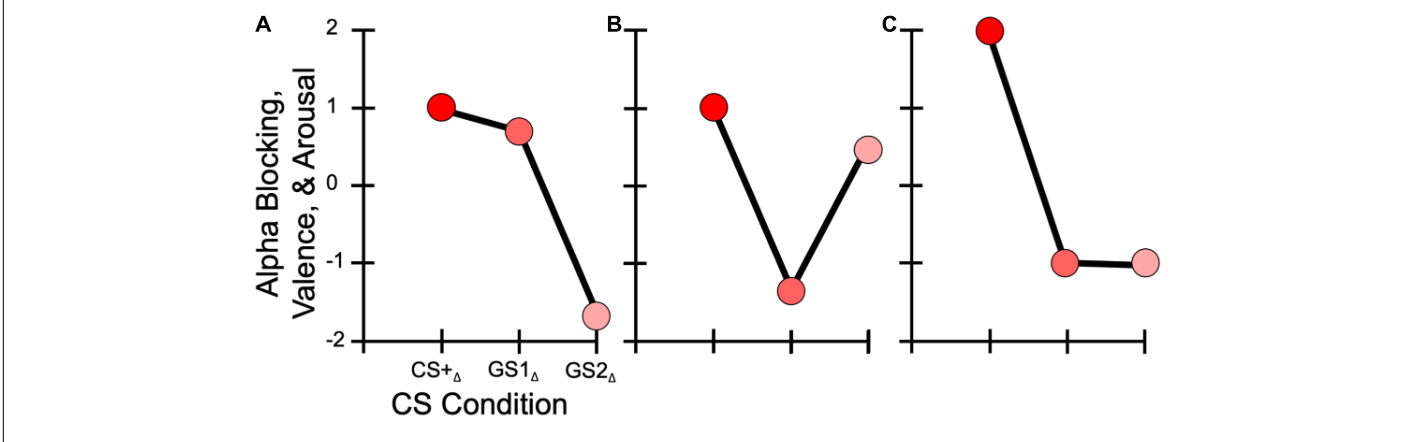
FIGURE 1 | Hypothesized learning model response patterns. (A) Generalization, with the GS1 eliciting a greater response than the GS2. (B) Sharpening, in which GS1 has a decreased response compared to the GS2. (C) All-or-Nothing, where the GS 1 and GS 2 display similarly decreased responses relative to the CS+.
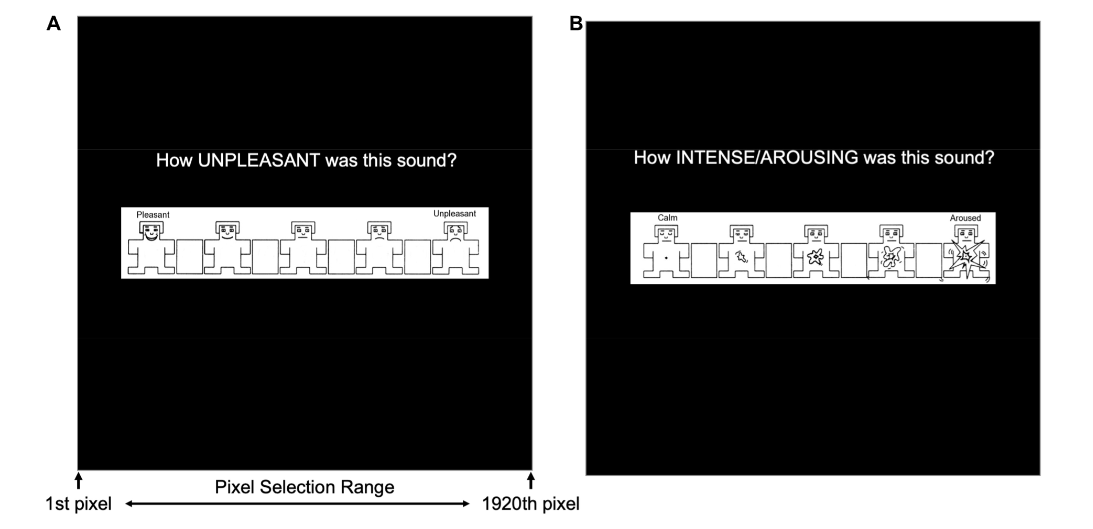
FIGURE 2 | Self-Assessment Manikin (SAM) presented to during the early and late stages of both the habituation and acquisition phases in the auditory aversive generalization task. (A) Measures of valence quantified by pixel number (i.e., 1–1,920) corresponding with participants’ mouse click on an x-axis of the monitor’s length. (B) Measures of arousal were similarly represented by pixel number corresponding with participants’ mouse clicks.
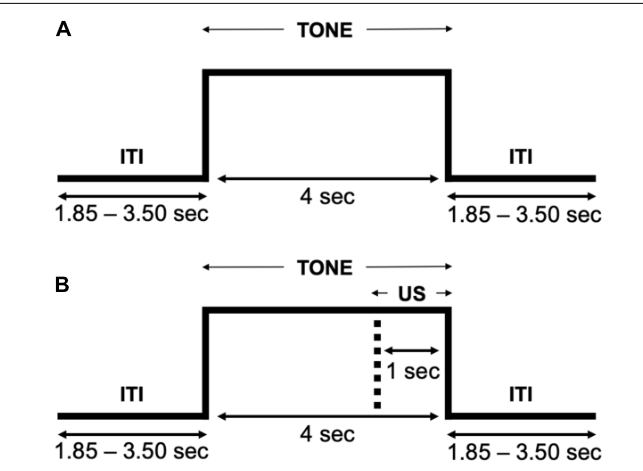
FIGURE 3 | Trial flow of the auditory aversive generalization task. (A) The habituation phase presented a tone (each pitch) without any white noise US pairings. (B) The acquisition phase presented a tone (each pitch) with the lowest pitch being paired with the white noise US.
contextual statement
In a 2022 study, Ward attempted to determine whether self-reported Misophonia symptoms are associated with auditory aversive generalization learning by conditioning 34 undergraduate participants to a CS+ tone paired with white noise and comparing behavioral (valence/arousal) and EEG parietal alpha-band power responses across CS+ and generalization stimuli, using the Misophonia Symptom Scale to quantify symptom severity.
summary statement
In a 2022 study, Ward et al. examined whether Misophonia symptoms relate to overgeneralized versus discriminative aversive learning by pairing one of three sine-wave tone pitches with a loud noise US and measuring self-reported valence/arousal and parietal alpha-band power across habituation and acquisition phases. They found that an all-or-nothing discrimination model best fit both behavioral and alpha-power data overall, and that higher MSS scores were associated with more pronounced all-or-nothing discrimination learning in alpha-band power, while affective ratings (valence/arousal) were elevated with MSS regardless of conditioning. From this they concluded that Misophonia is not characterized by overgeneralized aversive learning, but instead may involve heightened discrimination and general aversive/defensive sensitivity to auditory stimuli.