Properties (17)
Id 7d99393f-3e6f-4ea0-96cc-6ffcd0de56d8
Year 2019
Abstract
Cssclasses
- purpleRed
Aliases
- (Schröder et al., 2019)
Import Date 05-01-2024
Template Version Notes •corrected error in rendering the linked PDF in metadata section • added the tag “noted” to the definition of comments to ignore ( like with the “in another note” tag. this is so that when making notes on chapters of a textbook, i can still export things for manual addition to the obsidian note without having to keep track of what has already been added ). Also moved the version notes to the yaml section • this version added the bookmarks section to auto collect all bookmarks. it also dropped the template auto fill of the initial source field because we never got it working and just overwrote it manually anyway. this version also added logic to handle “in another note” tag. annotations marked with this are completely ignored. used when i have information covered in a bigger note, but still want to highlight that part in text for visual clarity (so as to avoid duplicates of the same information) • running the import more then once will overwrite the file, so do not import again if you have made changes in obsidian that are not in the zotero article.
Dissertation Source Tags
- fMRI
- neuro
- #Misophonia
- auditory processing
- salience network
- ACC
- insula
- amygdala
- ECG
- aversive sounds
- HR
Quick Cites 1
Dv Initial Source >
Dv Status #status/reviewed
Dv Relevance • study showing changes in fMRI in Misophonics exposed to triggers, showing evidence of abnormal activity of the auditory cortex and salience network • Author was the “first” to describe a diagnostic criteria for Misophonia • authors pontificate on their results in a way that supports the idea of Misophonia growing from an initial physiological/emotional response that gets reinforced over repeated exposures. • results support (Kumar et al., 2017) WARNING: this article was reviewed fairly well, but not many notes taken due to time crunch. it is marked as reviewed but for more details a re-review might be needed. bookmarks to potential points of interest have been included.
Dv Limitations • lack of ecological validity in stim presentation • stim selection did not account for full variety of stim that could maximally trigger someone. • possible selection bias in sample • limitation in the small number of stimuli with very little control across stim (ex: did not control audio levels)
Dv Future Directions N/A
Checked For Zettle Notes true
Zotero Note Link Generated true
Initial Source Misophonia MOC
•
Misophonia is associated with altered brain activity in the auditory cortex and salience network
Status:: #status/reviewed
Metadata
- Item Type: #journalArticle
- Authors: Arjan Schröder, Guido van Wingen, Nadine Eijsker, Renée San Giorgi, Nienke C. Vulink, Collin Turbyne, Damiaan Denys,
- Date:
- Date Added: 1590271518000
- URL: http://www.nature.com/articles/s41598-019-44084-8
- DOI: 10.1038/s41598-019-44084-8
- Cite Key: schroderMisophoniaAssociatedAltered2019
- Topics: [object Object],[object Object],[object Object]
- Tags: #Misophonia, #added-to-Misophonia-data-base, #reviewed, #Neurology, #selected, #my-dissertation,
- PDF Attachments
Article Review Table: (Schröder et al., 2019)
| Background/Purpose | Background- • Misophonia impairs life but research is still young ( at time of pub) and is not widely accepted as a distinct disorder. • there is a need to develop an understanding of the neurobiological mechanism of Misophonia to support Misophonia as a independent disorder, which would incentivize more work into the issue. • the neurobiological mechanism of Misophonia has yet to be looked at regularly (at time of pub) • in their previous EEG study (Schröder et al., 2014)found evidence of deviant auditory processing in Misophonics which could be a big part of Misophonia response formation. however, EEG limits the anatomical specificity of where you can say the effects were, and it is likely that Misophonia involves multiple brain areas (emotion limbic structures). • such areas can be assessed with fMRI, and other studies like (Kumar et al., 2017) have shown abnormal fMRI activation in Misophonia Purpose- • identify the brain regions involved in the Misophonic emotional response. specifically areas invlved in processing sounds and aversive stim predictions • different neural activity in Misophonics compared to controls n response to triggers • activation of salience network (insula and ACC) in Misophonics • enhanced amygdala activity in Misophonics (pdf) |
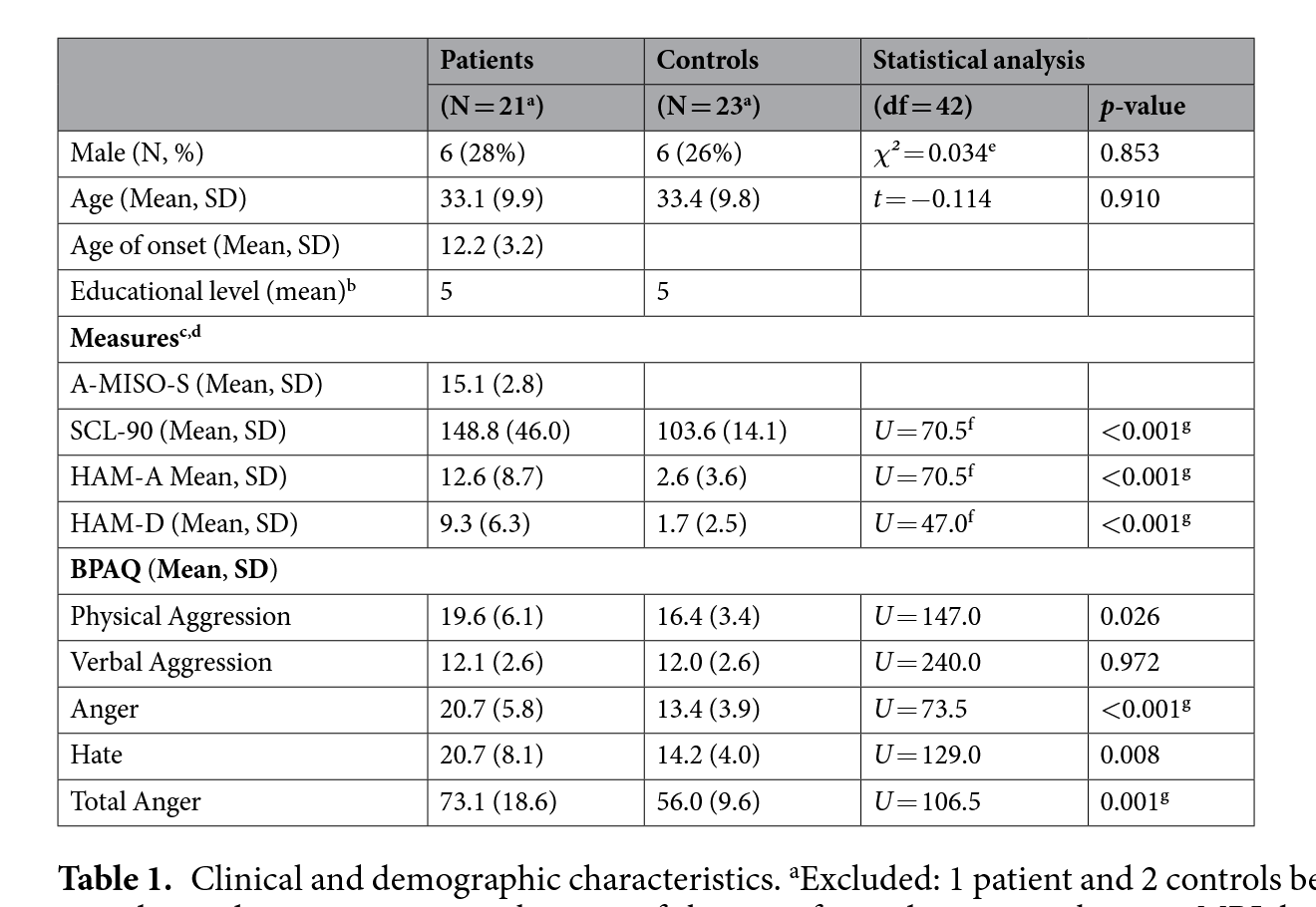
| Participants/samples | • of the data collected, data for 4 Misophonics and 2 controls was dropped for reasons described in table 1. the descriptions of subjects below this line refer to the subjects kept for final analysis., • 21 adult Misophonics (as diagnosed by 3 psychiatrists with experience with Misophonia), 25 sex and age matched controls • exclusion criteria: a diagnosis of major depression, anxiety disorder, BPD, psychotic disorder, ASD, substance related disorder, hearing loss, MRI contraindications, epilepsy or stroke within the last year |
| Measures | scales • Amsterdam scale scores • Dutch version of SCL-90: gives score indicating levels of psychoneuroticism • Hamilton anxiety rating scale (HAM-A) • Hamilton Depression Rating Scale (HAM-D). • Dutch version of the Buss-Perry Aggression Questionnaire (BPAQ). Visual analogue scale (VAS) physiological • ECG • inter-beat-intervals • fMRI • Dutch version of the Profile of Mood States (POMS-SF)21,22 was used to rate mood and level of arousal, |
| Procedures | stimuli- • triggering/aversive/neutral video clips categorized using self reports from pilot data. (pdf) procedures • presented clips in diff conditions ( aversive, trigger, neutral) while fMRI data collected. stim delivered in blocks. each stim presentation was presented for 25 s, with blocks pseudorandomized and order of videos per block randomized. • four blocks per condition. • gave self reports of changes in emotion in response to each stim presentation at un specified intervals. |
| Results | • sig diff in emotions evoked n Misophonics vs controls by condition. specifically saw more anger, disgust and depression symptoms, anger then controls. • no diff between groups in response to generally aversive stim. Misophonics showed sig greater increases in anger post session then controls did. • no diff in Misophonic group for the trigger vs aversive stim condition. • found sig effects of group and condition on heart rate resposnes (pdf). • trigger exposure resulted in physiological arousal, and increased activity in rights insula, right ACC, and right Superior temporal cortex |
| Discussion/Limits | Conclusion- • recruitment of insula, ACC, and superior temporal cortex suggests role of salience network in Misophonia • lack of diffs in resposnes between Misophonia and control to aversive stim suggests subthreshold resposnes to aversive stim for Misophonics and exaggerated resposnes to triggers in Misophonics (pdf) • recruitment of ACC and superior temp cortex suggests role of salience attribution in Misophonia. basic idea proposed by authors follows the classical conditioning view where triggers initially evoke physiological response + negative emotions, with subsequent exposures strengthening these associations. these resposnes also get augmented by hypervigilance (pdf) • increased HR for Misophonics in trigger and aversive codntions suggests autonomic arousal as suggested by Edelstein 2013, indicating extreme aversive reactions in Misophonics in general. • increased BOLD resp in right ACC and insula implicate the salience network in Misophonia (pdf) • no sig difference in amygdala activation. this implies that fear/anxiety is not a primary emotion in Misophonia, though anticipatory anxiety for trigger exposure is still possible (pdf). • results support Kumar 2017 (page 1) |
| Limitations:: | • lack of ecological validity in stim presentation • stim selection did not account for full variety of stim that could maximally trigger someone. • possible selection bias in sample (page 7) • limitation in the small number of stimuli with very little control across stim (ex: did not control audio levels) (page 3) |
| Relevance:: | • study showing changes in fMRI in Misophonics exposed to triggers, showing evidence of abnormal activity of the auditory cortex and salience network • Author was the “first” to describe a diagnostic criteria for Misophonia (Schröder 2013) • authors pontificate on their results in a way that supports the idea of Misophonia growing from an initial physiological/emotional response that gets reinforced over repeated exposures. • results support (Kumar et al., 2017) WARNING: this article was reviewed fairly well, but not many notes taken due to time crunch. it is marked as reviewed but for more details a re-review might be needed. bookmarks to potential points of interest have been included. |
Notes
my engagement notes
my questions
my comments
- I am not a fan of this article. primarily de to the structure of the article itself, as well as some questionable methods ( ex: small stim sets with little to no controlling for irrelevant psychoacoustic features (ex: did not normalize the audio levels across clips.)) (page 4)
Bookmarks
-
bookmark describing the scales used (page 3)
-
bookmark talking about the data analysis (page 3)
-
bookmark for hear rate results (page 4)
-
bookmark describing the stim (page 3)
reading notes
- the authors believe Misophonia is best described via psychiatry (page 1)