Properties (11)
- purpleRed
- (Dibb et al., 2026)
A qualitative investigation of living with misophonia
Status:: #status/reviewed
Metadata
- Item Type: #journalArticle
- Authors:: Bridget Dibb, Anya Sharman, Takunda Karima,
- Date:
- Date Added: 1784862751000
- URL:
- DOI: https://doi.org/10.1177/13591053261464343
- Cite Key: dibbQualitativeInvestigationLiving2026
- Tags:: #Misophonia, #qualatative, #reviewed, #thematic-analysis,
- PDF Attachments
Abstract
| Background/Purpose | Background- • Misophonia is an extreme emotional and physical response to auditory triggers, a sensory intolerance to everyday sound not related to sound intensity; recognised as distinct from other conditions but still unclassified by ICD-11 and DSM-V. • Consensus now defines it as "a disorder of decreased tolerance to specific sounds or stimuli associated with such sounds" (Swedo et al., 2021). • Lifelong condition usually beginning in childhood or adolescence; cause unknown and debated; reported incidence varies widely (3.2%–60%). • Triggers mostly auditory (mouth/eating, nose/breathing), some visual (repetitive movements); typical response involves both emotive (anger, anxiety, disgust) and physiological (increased heart rate, sweaty palms) responses. • Most misophonia research is quantitative (causes, predictors, associations); the day-to-day lived experience is understudied. • Few qualitative studies exist; prior small ones (focus group n=7; interview n=5, preprint) reported anger and rage, feeling others responsible, lack of autonomy, feeling "bad", out of control, and negative impact. Purpose- • Provide an in-depth, larger-sample qualitative understanding of the individual's experience of living with misophonia. |
| Participants/samples | • N=24 with self-reported misophonia, recruited from the Misophonia Institute, USA. • Inclusion: over 18 years, self-reported misophonia; all completed the MRS. • Mostly female (n=20); mean age 40.8 years (range 19–63); majority white; time since first symptom ranged 4–55 years. • Reported as similar to other misophonia samples in age and gender skew; a comparison study (Dibb and Golding, 2022) reported a slightly lower MRS weighted score. |
| Measures | • Misophonia Response Scale (MRS; Dibb et al., 2021), 7-point Likert, magnitude of typical misophonic response. • Semi-structured interview schedule (open, participant-led, with follow-up and prompt questions); piloted on two people with misophonia, with no changes made. |
| Procedures | • Purposive sampling; recruitment advert forwarded by the Misophonia Institute; study information and screening via Qualtrics. • Interviews conducted via Teams by two interviewers (12 each, 24 total), averaging 44 minutes, recorded and transcribed verbatim. • Critical-realist epistemology; inductive, reflexive thematic analysis (Braun and Clarke, six steps); initial coding and clustering by two authors, further clustering and theme development by all three. |
| Results | Theme 1: Experience of a misophonic response • Emotional response: all participants reported strong emotions, chiefly anger, rage, and disgust; aggressive thoughts and imagery reported, tied directly to the trigger and stopping when the trigger stops; some described responses as panic attacks. • Physiological response: raised heart rate, muscle tension/rigidity, sensations described as electrical shocks, and unwanted sexual arousal, sometimes prompting leaving the area. • Behavioural response: involuntary (distinct from coping), including hypervigilant scanning, staring, urge to flee, physical aggression, and involuntary mimicking of the sound. Theme 2: Perceived impact of living with misophonia • Self-esteem: negative self-view, including feeling a "terrible person", self-hatred, "monster", and feeling selfish/difficult to live with. • Relationships: trigger-related emotions impacted close romantic and child-parent relationships, with guilt, hate, and in some cases relationship breakdown. • Daily life: avoidance restricted social eating, family events, car journeys, study/career, and work relationships, reducing sociability. Theme 3: Influencing factors • Coping: avoidance was the common mechanism (avoiding completely, controlling the environment, planning outings/mealtimes, blocking with earplugs or looking away, distraction, and sometimes confronting the person). • Feeling understood: discovering others with similar experiences brought relief and reduced isolation, enabled disclosure, and normalised the condition. • Exacerbating factors: stress increased susceptibility, severity, and recovery time and grew the number of triggers; anticipation of the trigger and the identity of the person (especially family who know and still make the noise) worsened responses. |
| Discussion/Limits | Conclusion- • The findings give in-depth, contextual detail (sudden onset, difficulty in the moment) beyond what quantitative measures capture, supporting prior reports of anger, anxiety, disgust, irritation, and a minority reporting unwanted sexual feelings. • Behavioural responses are automatic and instinctive, as opposed to coping, which is deliberate and effortful (Lazarus and Folkman, 1987); staring and hypervigilance reflect attempts to control the situation, and mimicking supports earlier work. • Misophonia negatively impacts self-worth, consistent with adjustment models such as Cognitive Adaptation Theory positing a common drop in self-esteem (Taylor, 1983). • Impact on relationships and reduced social interaction (via avoidance) supports links to reduced quality of life; increased isolation is associated with loneliness and negative health outcomes such as depression and anxiety. • Feeling understood by similar others reflects a recognised therapeutic factor and experiential knowledge (Borkman, 1976), suggesting group therapies as a future treatment strategy. • Avoidance and environmental control are successful but essentially avoidant coping strategies that do not prepare for unavoidable triggers and have been shown to negatively impact quality of life. • Anticipated triggers, not only unpredictable ones, can bring about stress and exacerbate the response; family as trigger source is attributed to their knowing yet persisting. |
| Limitations:: | • Recruitment via the Misophonia Institute, USA, may exclude those not connected with the institute, who may differ. • Self-reported misophonia; despite MRS completion, cannot be certain participants had misophonia. |
| Future Directions:: | • Research into the social complexities of living with misophonia. • Development of effective coping strategies, which may also benefit others with sensory sensitivities. |
| Relevance:: | • an in depth thematic investigation into the Misophonic experience • a good source for qualitative / experience info about Misophonia, and a great source for quotes from Misophonics |
Notes
key terms and concepts
-
Misophonia – an extreme emotional and physical response to auditory triggers (e.g. eating sounds); a decreased tolerance to specific everyday sounds not related to sound intensity; defined by consensus as "a disorder of decreased tolerance to specific sounds or stimuli associated with such sounds" (Swedo et al., 2021).
-
Misophonia Response Scale (MRS) – a validated scale (Dibb et al., 2021) measuring the magnitude of the misophonic response, rated on a 7-point Likert scale for a "typical response" to a trigger.
-
Thematic analysis – a versatile method of exploring the meaning within personal stories, used here following the six steps of Braun and Clarke.
-
Critical-realist epistemology – the epistemological approach taken to develop themes from the interview data.
-
Inductive approach – analysis in which themes are developed from the data rather than imposed.
-
Reflexive approach – approach to data collection and analysis taken to reduce bias.
-
Avoidant coping strategies – strategies (avoiding, controlling the situation, blocking) that manage triggers but do not prepare the individual for unavoidable triggers (Lazarus and Folkman, 1987).
-
Experiential knowledge – concept (Borkman, 1976) that when uncertainty is high and information scarce, the best information source is others with the same condition.
my engagement notes
my questions
my comments
Bookmarks
-
Theme 1: The experience of a misophonic response (page 4)
-
Theme 2: The perceived impact of living with misophonia (page 6)
-
Theme 3: Influencing factors (page 7)
reading notes
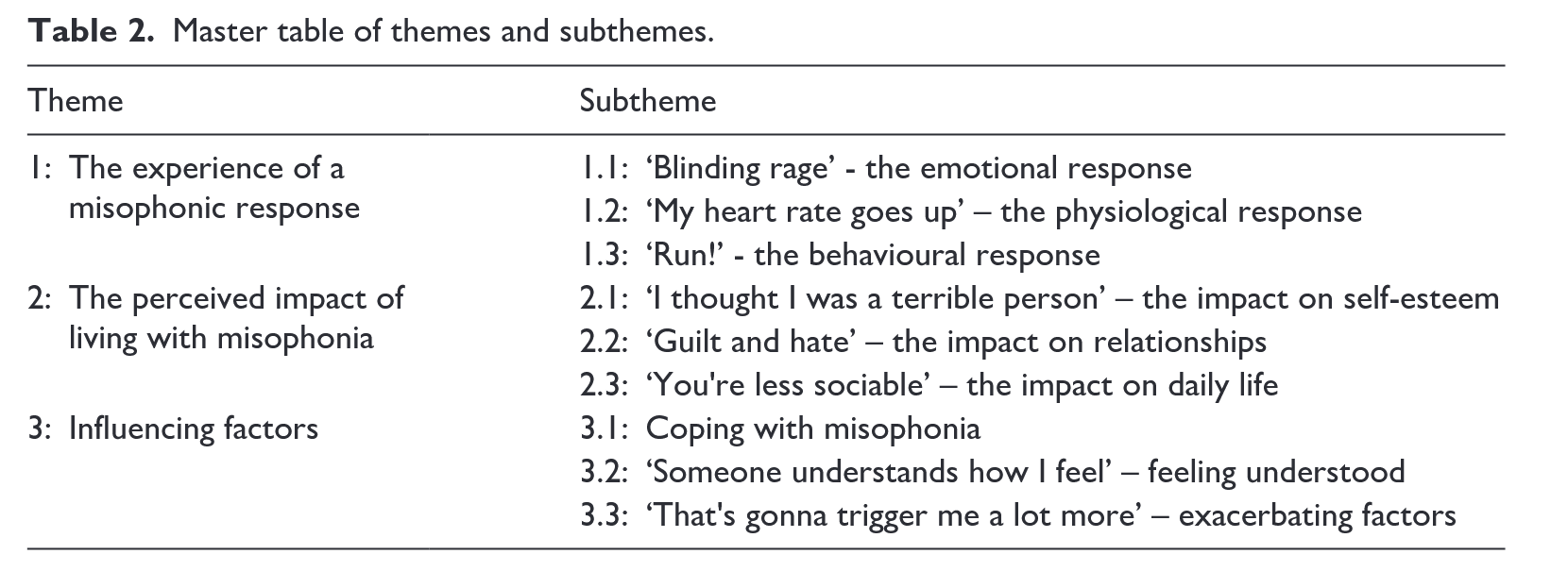
theme 1: the experience of the Misophonic response
(pdf)
- subtheme1.1: emotional response
- all reported strong emotional response such as anger and disgust
- reports of aggressive thoughts and the urge to forcibly stop the trigger source
- subtheme 1.2: physiological responses
- reports of increased heartrate, body wide electric shocks, and unwanted sexual arousal
- subtheme 1.3: behavioral response
- involuntary resposnes including staring at the trigger source, mimicking the sounds, and fleeing the area.
- reports of hypervigilance for trigger sounds
Theme 2: The perceived impact of living with misophonia
(pdf)
-
negative self evaluations/self esteem
- reports of self hatred, feeling like a bad person , and feeling selfish
-
impact on relationships
- negative effects on wide array of relationships ( friends, family, partners, children, parents)
-
impact on daily life
- avoidance behaviors
- impacts on education and work
Theme 3: Influencing factors
(pdf)
- coping
- avoidance, controlling surroundings ( asking people not to eat, using distractions) , using earplugs/headphones, looking away from trigger sources,
- feeling understood
- self reports of feelings of isolation
- found comfort in discussing with other Misophonics and learning that other people have the same issues.
- Exacerbating factors
- symptoms worse when stressed
- number of trigger sources grew over time
- impact of different people as being the source ( worse with family vs other)
- misattributing malicious intent ( people know I have Misophonia , so they are doing it on purpose)
contextual statement
In a 2026 study, Dibb attempted to provide an in-depth understanding of the individual's experience of living with misophonia by conducting 24 semi-structured interviews with adults with self-reported misophonia (screened with the MRS) and analysing them with inductive reflexive thematic analysis.
summary statement
In a 2026 study, Dibb explored the lived experience of misophonia by interviewing 24 adults with self-reported misophonia and applying inductive thematic analysis. They found three themes: the experience of the response (emotional, physiological, behavioural), the perceived impact (self-esteem, relationships, daily life), and influencing factors (coping, feeling understood, exacerbating factors), with avoidance the dominant coping strategy and feeling understood a source of relief. From this they concluded that targeting avoidant coping and raising awareness of treatment and support groups may help manage misophonia and reduce its negative impact.