Properties (17)
- purpleRed
- (Woolley et al., 2026b)
•
Psychological Correlates of Audiological and Self-Report Indicators of Hyperacusis in Adults With Misophonia
Status:: #status/Bare-bones-review
Metadata
- Item Type: #journalArticle
- Authors:: Mercedes G. Woolley, Karen Muñoz, Guadalupe G. San Miguel, Anderson Clements, Julie M. Petersen, Michael P. Twohig,
- Date:
- Date Added: 1771296634000
- URL: https://pubs.asha.org/doi/10.1044/2025_AJA-25-00200
- DOI: 10.1044/2025_AJA-25-00200
- Cite Key: woolleyPsychologicalCorrelatesAudiological2026
- Topics: [object Object]
- Tags:: #audiology, #Bare-bones-review-🦴, #clinical, #Misophonia, #pre-proof-copy,
- PDF Attachments
Abstract
| Background/Purpose | Background- • Misophonia and hyperacusis are distinct but can co-occur in a subset of individuals • Both linked to similar psychological difficulties - anxiety, depression, reduced quality of life • Preliminary findings suggest co-occurrence linked to greater misophonia severity and heightened emotional reactivity to auditory triggers • Assessment of hyperacusis in misophonia relies on self-report tools (Hyperacusis Questionnaire, IHS) and audiological methods (LDLs) • Best practice guidelines recommend combining self-report and audiological assessments • Self-report and audiological methods can yield discrepant results (e.g., individuals without complaints showing abnormally low LDLs) • Muñoz et al. (2024): 12% met self-report hyperacusis criteria vs. 25% met LDL criteria in a misophonia sample • Concern that self-report tools may not effectively differentiate misophonia from other sound sensitivity, risking conceptual overlap • No standardized protocol exists for LDL assessment • Hyperacusis thresholds vary widely across studies and differ depending on stimulus type (tonal vs. speech) • Few studies have assessed hyperacusis in misophonia treatment research Purpose- • Examine severity and clinical correlates (well-being, depression, anxiety, stress) of co-occurring hyperacusis using self-report and audiological methods • Conduct sensitivity analysis to evaluate whether different empirically supported LDL cutoffs affect hyperacusis classification and its association with psychological variables • Adopt exploratory approach given insufficient evidence for directional hypotheses |
| Participants/samples | • N = 60 adults (18+) seeking treatment for misophonia who met clinical cutoff criteria • Drawn from parent treatment trial (Bowers et al., 2024) • 261 screened, 232 eligible, 75 completed intake, 60 met inclusion criteria for final sample • 58/60 had normal hearing; 2 with mild hearing loss retained after ruling out loudness recruitment • 70% women, 98% White, 97% non-Hispanic, 77% heterosexual • Mean age 34 (SD = 12.18) • Participants received $60 for participating |
| Measures | • Misophonia Questionnaire (MQ) - 18 items; symptom, emotions/behaviors, and severity subscales; total score range 0-68 • Depression Anxiety Stress Scale-21 (DASS-21) - 21 items; depression, anxiety, stress subscales • Rage Outbursts and Anger Rating Scale (ROARS) - 3 items assessing rage frequency, intensity, duration; range 0-9 • Mental Health Continuum Short Form (MHC-SF) - 14 items; emotional, psychological, social well-being subscales • Inventory of Hyperacusis Symptoms (IHS) - 25 items across five domains; cutoff ≥69 used to classify hyperacusis • LDLs - tonal hyperacusis defined as mean LDL ≤90 dB HL across frequencies; alternate thresholds of one or two LDLs <90 dB HL also examined; speech hyperacusis defined as LDL ≤80 dB HL |
| Procedures | • Structured interview for misophonia plus structured psychiatric diagnostic assessment administered at intake • Battery of psychological and audiological self-report measures completed • Full hearing evaluation administered by audiology graduate research assistants under audiologist supervision • Conducted in double-walled sound-attenuated booth with calibrated equipment • LDLs obtained for warble tones and speech stimuli using the Contour Test of Loudness Perception |
| Results | Prevalence • More participants met LDL-based hyperacusis criteria than self-report (IHS) criteria at the mean, one-LDL, and two-LDL tonal thresholds; fewer met criteria via the speech LDL threshold than via self-report Convergence between audiological and self-report measures • LDL-based hyperacusis classifications (all four thresholds) not associated with IHS scores • Speech LDL group showed a trend toward higher IHS scores, but this did not reach significance • Overall, little to no convergence between audiological and self-reported hyperacusis indicators LDL-based hyperacusis and clinical outcomes • LDL-based hyperacusis groupings not associated with misophonia or psychological outcomes (null across all four thresholds) Self-reported (IHS) hyperacusis and clinical outcomes • Associated with greater misophonia-related emotional/behavioral reactivity • Associated with greater misophonia severity • Associated with elevated depression, anxiety, and stress • Not associated with MQ total score or symptom subscale • Not associated with anger (ROARS) or well-being (MHC-SF) |
| Discussion/Limits | Conclusion- • Results indicated a mismatch between audiological and self-report indicators of hyperacusis • LDL-defined hyperacusis was not associated with misophonia severity or broader psychological outcomes • Self-reported hyperacusis was associated with heightened emotional/behavioral reactivity, severity, and elevated depression, anxiety, and stress • Co-occurring hyperacusis and misophonia may amplify affective reactivity rather than increase breadth or frequency of misophonic symptoms • Overlap on self-report measures may reflect shared distress-based processes rather than truly distinct diagnostic categories • Hyperacusis may primarily intensify internalizing symptoms rather than externalizing responses like anger • Anger may be more uniquely linked to misophonia than to broader dimensions of sound intolerance • Hyperacusis classifications based on audiological criteria and self-report scores were unrelated, consistent with prior literature • LDLs have limited adequacy as a standalone diagnostic marker in misophonia samples • Speech LDLs may offer a more ecologically valid audiometric screener of hyperacusis than tonal stimuli • Most audiologists do not routinely obtain LDLs or assess for self-reported hyperacusis, representing a possible oversight • Caution warranted against directly comparing LDLs across studies given lack of standardized assessment protocols • Standardized assessment could enhance diagnostic accuracy, differentiation of sound sensitivity subtypes, and tracking of symptom severity over time • Self-report may better reflect the lived experience and clinical presentation of overlapping misophonia and hyperacusis |
| Limitations:: | • Relatively small, demographically homogeneous sample • Limited number meeting hyperacusis criteria, possibly reducing power to detect smaller effects • Few prior studies have directly assessed LDLs in adults with misophonia • No correction applied for multiple comparisons (exploratory approach) |
| Future Directions:: | • Identify psychometric measures that can accurately distinguish misophonia from hyperacusis • Develop standardized protocols for assessing hyperacusis in individuals with misophonia • Investigate how difficulty tolerating sound volume interacts with sensitivity to repetitive sounds to exacerbate distress • Expand research to larger, more diverse samples • Identify clinically meaningful subgroups for tailored assessment and intervention |
| Relevance:: | • looked at the use of LDL in Misophonia dxing, finding that LDL alone was not a good indicator of Misophonia and suggests that both audiological and self report measures should be used to distinguish between hyperacusis and Misophonia • they make a point to warn against comparing LDL’s across studies due to a lack of standardized assessment protocols (pdf). |
Notes
key terms and concepts
Misophonia – sound sensitivity disorder marked by intense emotional reactions to everyday repetitive sounds.
Hyperacusis – decreased tolerance to the loudness of typically non-aversive sounds.
Loudness Discomfort Level (LDL) – audiometric-based test of hyperacusis; the sound level at which a stimulus becomes uncomfortable.
Inventory of Hyperacusis Symptoms (IHS) – 25-item self-report measure of hyperacusis across five domains; cutoff ≥69 used to classify hyperacusis.
my engagement notes
my questions
my comments
Bookmarks
reading notes
-
In a 2026 study, Woolley examined the convergence between audiometric and self-reported indicators of hyperacusis by administering self-report measures ( and loudness discomfort level (LDL) testing to 60 treatment-seeking adults with misophonia. the authors note that even though they found self reported hyperacusis was linked to heightened emotional/behavioral reactions to triggers sounds, it was not linked to increased MQ total or symptoms scores. they propose this could indicate that the co occurrence of the conditions enhances affective reactivity rather then increasing the breath/reactivity of Misophonic resposnes. (page 12)
-
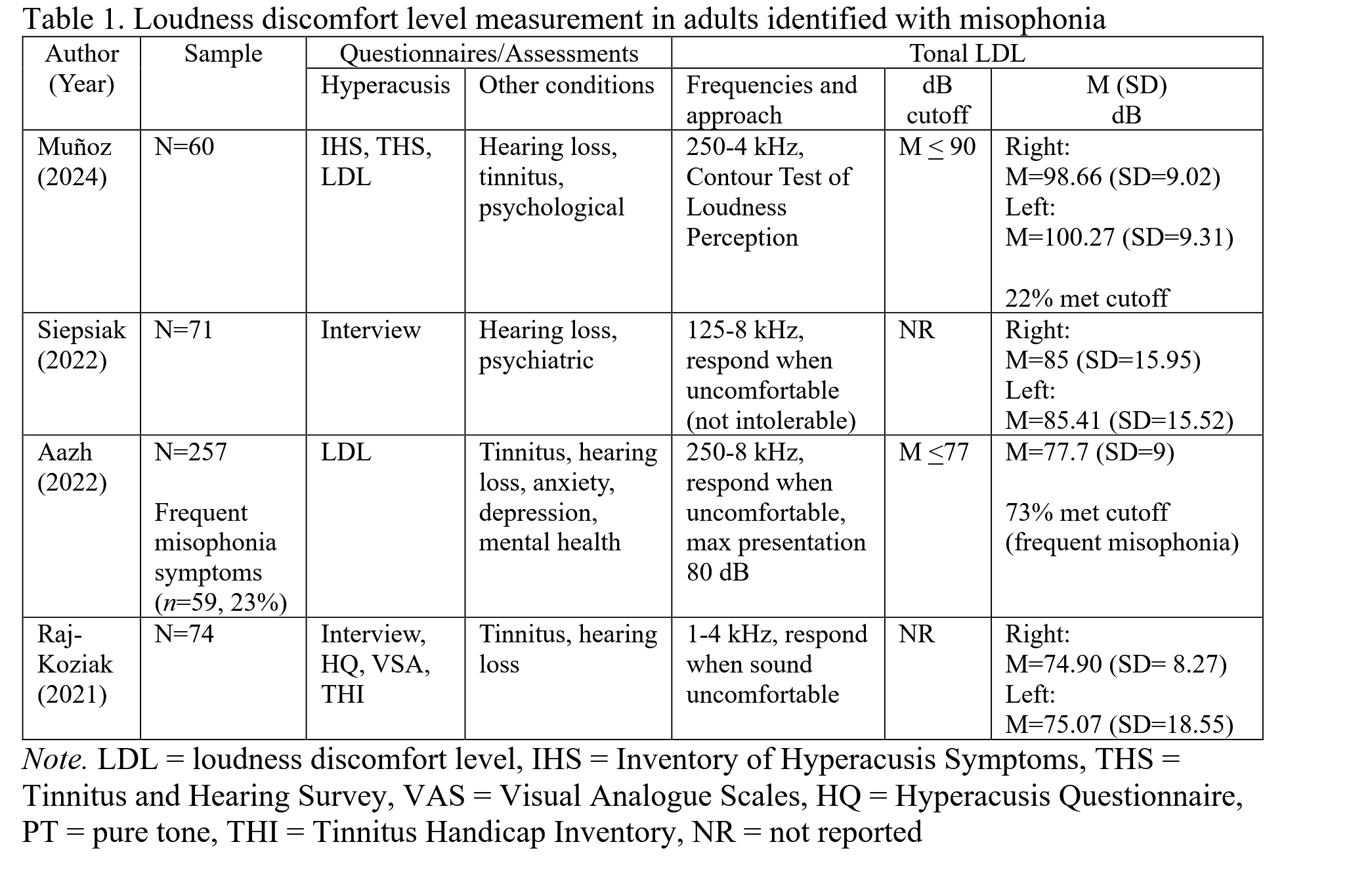
they make a point to warn against comparing LDL’s across studies due to a lack of standardized assessment protocols (page 14)
-
While cautioning against direct comparison of LDLs observed across studies due to no standardized assessments (pdf), the Woolley et all discuss how those with co-occurring Misophonia and hyperacusis can have LDLs ranging from 30dB Hl to 120 dB HL, in contrast to the standard < 80dB HL for those with only hyperacusis (pdf) (page 14)
contextual statement
In a 2026 study, Woolley attempted to investigate the convergence between audiometric and self-reported indicators of hyperacusis by administering self-report measures (IHS, MQ, DASS-21, ROARS, MHC-SF) and loudness discomfort level (LDL) testing to 60 treatment-seeking adults with misophonia.