Properties (8)
- purpleRed
- What sound sources trigger misophonia?
- (Hansen et al., 2021)
- aversive sounds
- Triggers
What sound sources trigger misophonia? Not just chewing and breathing
Status:: #status/reviewed
Metadata
- Item Type: #journalArticle
- Authors: Heather A. Hansen, Andrew B. Leber, Zeynep M. Saygin,
- Date:
- Date Added: 1698637618000
- URL: https://onlinelibrary.wiley.com/doi/10.1002/jclp.23196
- DOI: 10.1002/jclp.23196
- Cite Key: hansenWhatSoundSources2021
- Topics: [object Object],[object Object],[object Object]
- Tags: #diagnosis, #reviewed, #Highlighted-source, #Auditory, #selected, #auditory-features-of-aversive-stim, #machine-learning, #sound-aversion, #sound-sensitivity, #source-categories,
- [PDF Attachments]([Hansen et al_2021_What sound sources trigger misophonia.pdf](file://C:\Users\attra\Zotero\storage\P4KX4RCT\Hansen%20et%20al_2021_What%20sound%20sources%20trigger%20misophonia.pdf))
Article Review Table: (Hansen et al., 2021)
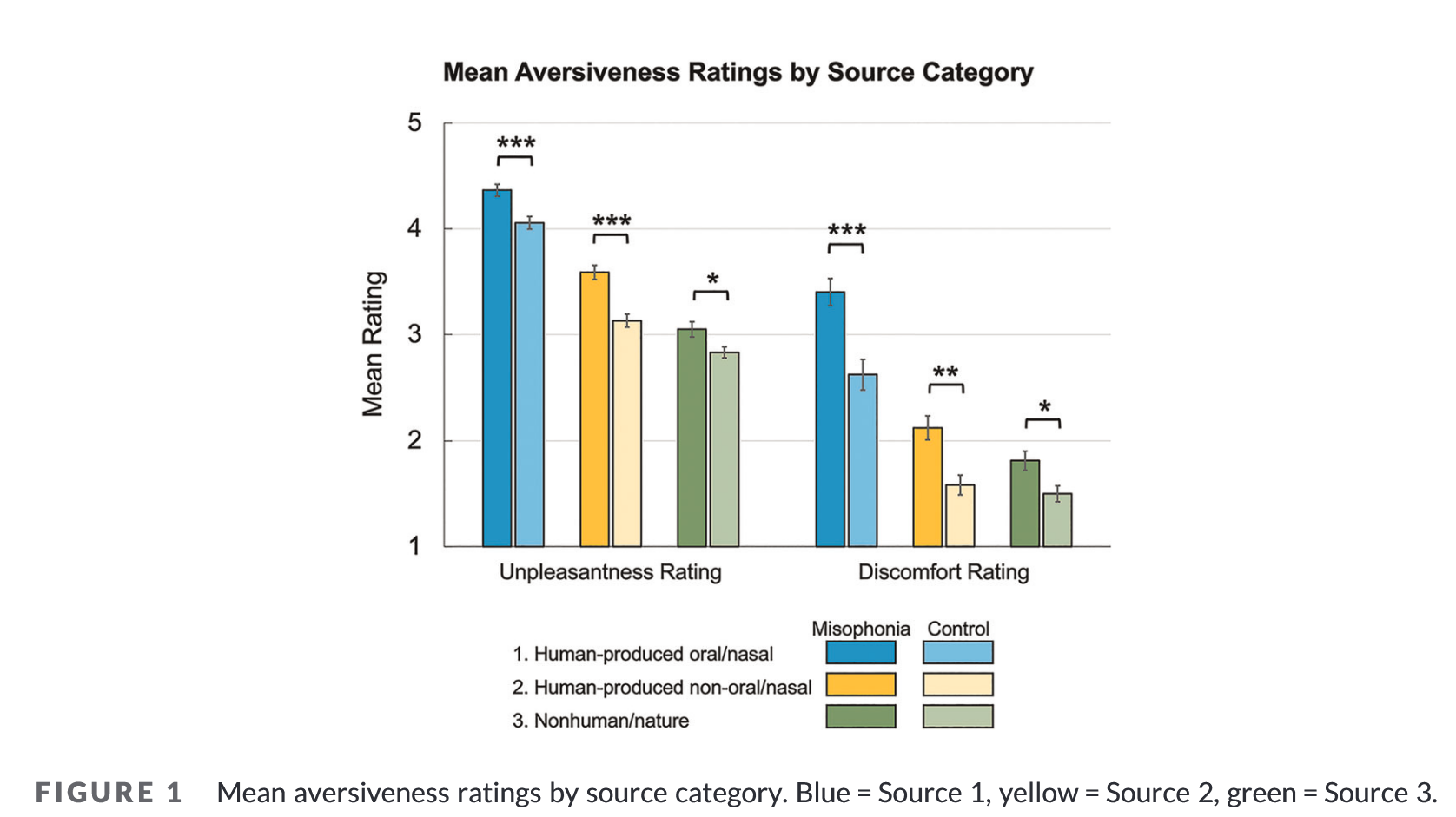
| Background/Purpose | Background- • Most research into Misophonia focused on triggers consisting of human made orofacial sounds, but there is evidence that triggering stim can go beyond this stimulus set. • there is a lack of experimental data to show if sounds must be human made in order to be triggering • the vagueness of existing descriptions of Misophonia and the reliance on interviews shows the necessity of an empirical look at the kinds of sound that can become triggers. Purpose- exp1 • goal is to assess if/how the source of a sound influences how triggering it is (page 3) exp2 • replicate EXP1 results with larger stim set • identify subjects Misophonia status and predict level of Misophonia using just the discomfort ratings. • assess if the most informative triggers are mainly human made oral/nasal sounds (page 7) |
| Participants/samples | EXP1 sample- • 48 self -identified Misophonics (at least a 4/10 on the MAS-1) • 39 controls (scored less then 4 out of 10 on the MAS-1) Stimuli- • 30 auditory clips from freesound.org. sounds consisted of those commonly cited as triggering, everyday background sounds with similar spectral/pattern characteristics, • divided into human produced oral/nasal sounds (source1); human produced non-oral/nasal sounds (source2) ; non-human/nature sounds (source 3) • all sounds were 15s long, EXP2 sample- • 45 self identified Misophonics ( scored ≥ 4 on the MAS-1 OR if say yes when asked if they think they have Misophonia ), with one having taken part in EXP1 • 50 controls (scored < 4 on the MAS-1) and did not answer yes when asked if they think they have Misophonia stimuli- same as in EXP1 + 95 additional sounds were gathered and sorted into the categories |
| Measures | EXP1 measures- • Misophonia activation scale (MAS-1) • Misophonia Assessment Questionnaire (MAQ-2) • Amsterdam Misophonia scale (A-MISO-S) • Obsessive Compulsive Inventory‐Revised (OCI‐R;) • Depression Anxiety Stress Scale‐21 (DASS‐21) EXP2 Measures- same as in EXP1 + the IPIP Big‐Five personality scale, and directly asking subjects if they thought they had Misophonia |
| Procedures | EXP1 • accessed a Qualtrics survey online and took around 30-60 minutes. had to use headphones during the task (verified through headphone check) and instructed to adjust volume to comfort. only those passing the headphone check and had a browser supporting flash proceeded. • subjects shown 30 auditory clips sequentially for 15s each. subjects heard that entire sound before being prompted to identify the sound using a textbox and then ratting the aversiveness they felt to the sound (5-point ordinal scale). responding took at least 5 seconds • subjects debriefed after completing all sounds , including giving information on Misophonia • they then filled out the demo sheets and filled out the scales ( this part at the end to avoid demand characteristics. ) (page 3) EXP2 procedure- same as in EXP1 but with a change to the sounds and rating presentations. : • sounds were presented with labels describing the sound to eliminate confounds of subjects not identifying some stim (namely the impact of the aversiveness scores that misidentification caused in exp1). this also preserved ecological validity (Misophonics usually have context to identify sounds) • stimuli length was variable, so subjects did not have to listen to whole stim, just enough to identify the source. compliance with the requirement to play every stim was checked using catch trials ( they were previously told to give a specific answer to these trials) and only data from subjects who passed all check trials was analyzed. • because stim were presented with labels, subjects did not have to report what the source was, just give the aversiveness rating (page 8) • they allowed people to choose when to stop listing to sounds, but ensured that they did play every sound using check trials. (page 9) |
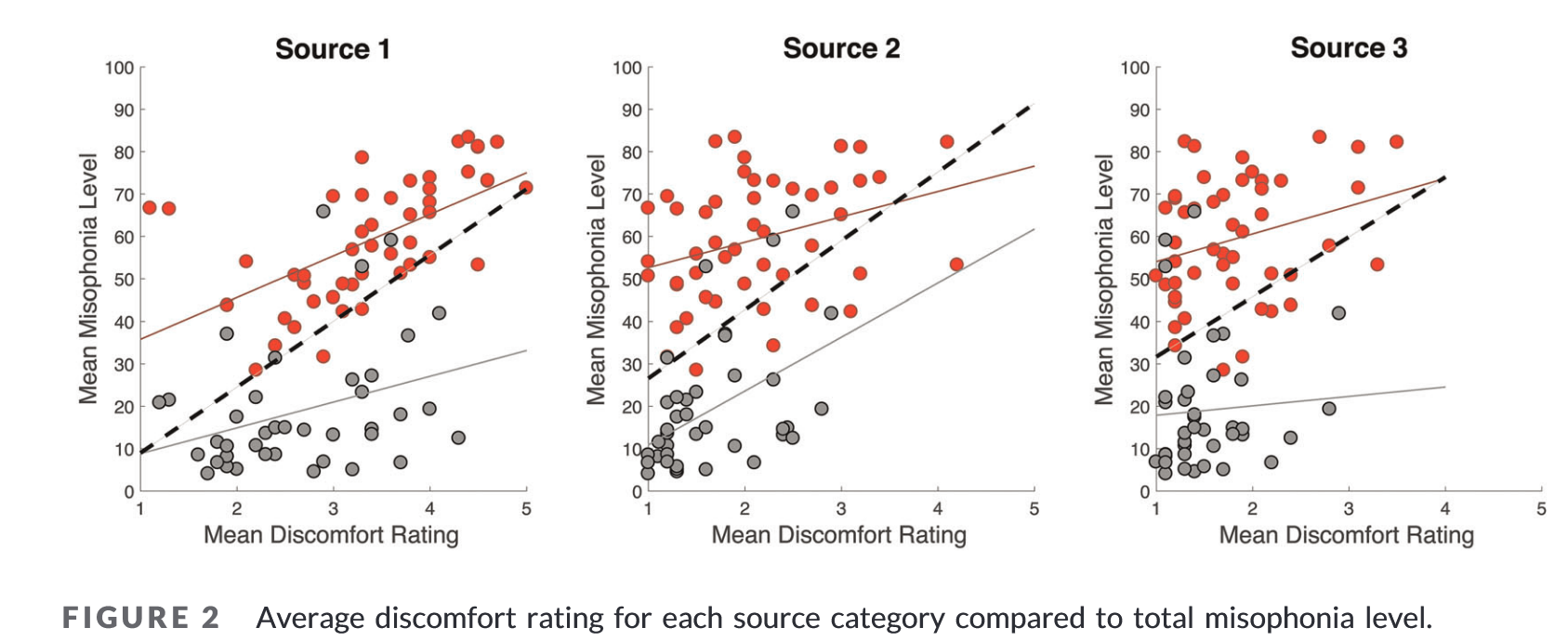
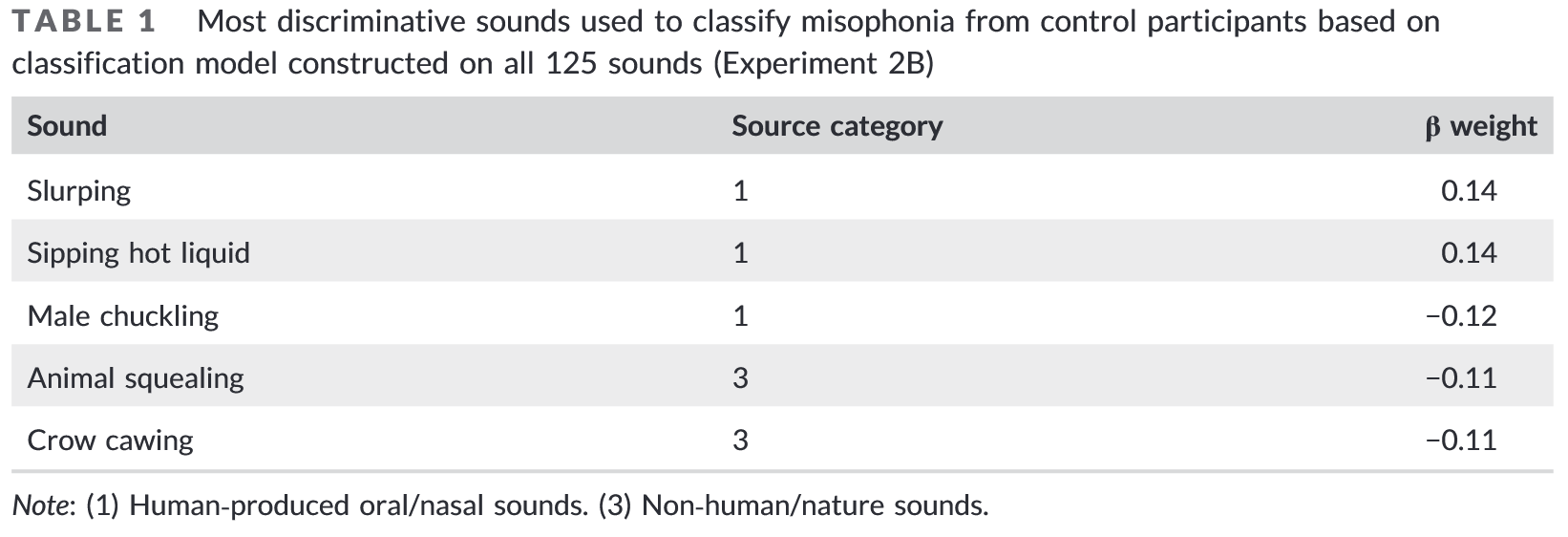
| Results | EXP1 • controls show some discomfort with some sounds, Misophonics show far more extremer responses dependent on the sound source category ( i.e Misophonics show little difference in response to non-human sounds compared to controls) (page 6) EXP2 • Misophonics reported source 1 and 2 sounds as more aversive then controls did, replicating result from EXP1 • linear classification reveled the top 5 most informative sounds for identifying Misophonics (see table 1). top 50 sounds and rankings are shown in figures S10 and S8A respectively (page 10) • results support previous findings that animals/babies are not typically triggering (page 14) |
| Discussion/Limits | Conclusion- EXP1 • results suggest that controls acknowledge human oral/nasal sounds as bothersome to a lesser extend, but diverge greatly when it comes to non-orofacial sounds, as Misophonics still showed much greeter aversion to such sounds compared to controls. consideration of human nasal/non-nasal sounds could be useful for dxing (page 7) • results suggest that Misophonics experience different averseness to sounds depending on the sound source. • rational for EXP2: is this result generalizable/reliable and can it be used to identify Misophonics from controls based only on self reported discomfort to the stimuli? (page 7) EXP2 using the same 30 stim from EXP1 + the new stim from EXP2 confirmed and strengthened the findings from EXP1 in regard to the observed correlation between Misophonia level and reported discomfort to the stim. • machine learning methods showed self reported aversiveness to triggers reliably predicted Misophonia level] • some of the most predictive stim feel outside of the oral/nasal category, suggesting that limiting Misophonia stim to just these sounds misses a significant amount of variability in Misophonic triggers. the main thing is that the triggers mostly come from humans. • results suggest that discomfort ratings were unrelated to demographic/clinical measures alone, because if the Misophonic experience was mainly driven by things like OCD level or other demographic variables, the modeling that regressed these factors out should not have been as significant as they turned out to be. this also suggests miso to be a distinct clinical condition (page 12) • modeling based on self reported aversion reliably predicted miso level (page 13) • results suggest that discomfort ratings were unrelated to demographic/clinical measures alone, because if the Misophonic experience was mainly driven by things like OCD level or other demographic variables, the modeling that regressed these factors out should not have been as significant as they turned out to be. this also suggests miso to be a distinct clinical condition (page 14) Limitations- • a major limit of the present paper is the reliance on self reports. the author hold that such measures are prone to response bias, for instance, a Misophonic may rate sounds as more aversive based on the belief that it SHOULD be more aversive. this also highlights the need for an objective measure of misophonia • the online recruitment method used means that symptoms could not be clinically assessed. (page 15) |
| Relevance:: | • results showed that the most useful triggers to use when separating Misophonics from controls span human made oral/nasal sounds AND non-oral nasal sounds. basically showing that trigger sets should focus on making them Human sourced rather then strictly mouth/nasal sounds. • results support idea of Misophonia as a distinct clinical disorder. • cites an example of trigger exposure hindering learning • gives a good example of what counts as generally aversive sounds • good source for info on the different types and sources of triggers. also emphasizes the need to account for different trigger types beyond the standard human orofacial sounds when studying Misophonia. • has a comment about how the use of of self reports for miso intensity suffers from bias, highlighting the need for an objective measurement. this could be very relevant to the MisoResp project/my dissertation. |
Notes
my engagement notes
my questions
my comments
Bookmarks
-
bookmark talking about the stim used (page 3)
-
bookmark for EXP2 methods (page 8)
-
bookmark describing preregistration and the deviation from preregistered analysis planes (page 9)
-
bookmark for EXP2 results (page 10)
reading notes
characteristics of generally aversive sounds
-
generally aversive sounds are those that induce immediate aversive resposnes in the listener
-
most generally aversive sounds can be characterized as loud, rough and high frequency. they are also often associated with negative reactions that aid in survival. (Halpern et al., 1986)**NOTE: could not validate this citation statement ** (page 2)
-
the author cites (Seaborne & Fiorella, 2018) as an example showing declining cognitive performance in the presence of triggers. a quick look at the abstract supports this citation statement (page 2)
- authors propose that limiting triggers sets to just oral/nasal sounds reduces experimental generalizability, ignores the experiences of Misophonics with different triggers, and could hinder progress in understanding/treating the condition. (page 15)