Properties (1)
- the larger context of this major topic is in the linked parent note
this note should be used to organize data on diagnostic tools, methods, and procedures. - see the outline guide
1. Diagnostic Definitions & Criteria
bold-headers
Centrality of panic specifically supports the Swedo definitions emphasis on emotions beyond hatred
Shan et al. (2024) applied EBIC gLASSO network analysis to Duke Misophonia Questionnaire (DMQ) data from 144 adults with varying levels of misophonia severity and found that "I felt panic" was among the highest-influence items in the symptom sub-network, second only to the internalizing cognitive response "I need to get away from the sound." The authors specifically noted this finding as support for the Swedo et al. (2022) consensus definition, which characterizes misophonia as producing a range of emotional responses and explicitly argues against reducing the condition to "hatred of sound." They concluded that the centrality of panic in the symptom network underscores the importance of capturing diverse affective responses, including internalizing emotions, in both the conceptualization and assessment of misophonia (Shan et al., 2024).
bold-headers
Centrality of impairment in Misophonia network analysis supports DMS classification as distinct condition
Network analysis of Duke Misophonia Questionnaire (DMQ) data from 144 adults with varying misophonia severity revealed that the DMQ Impairment subscale had the highest expected influence of all subscales in the overall misophonia network, for both males and females (Shan et al., 2024). The authors noted that this finding aligns with the Diagnostic and Statistical Manual of Mental Disorders (DSM) framework, in which functional impairment is a key criterion for diagnosing psychiatric disorders. While explicitly stopping short of making specific classification recommendations, they identified the centrality of impairment as a key factor to consider in future discussions about categorizing misophonia as a credible, distinct clinical entity within existing diagnostic frameworks (Shan et al., 2024).
bold-headers
Swedo 2022 definition of Misophonia
In a 2022 Delphi study, Swedo et al. aimed to develop a consensus definition of misophonia for the scientific community by using a modified four-round Delphi method in which a multidisciplinary expert committee systematically evaluated and voted on definitional statements extracted from the published literature. They found that, from 68 references yielding 551 candidate statements, 93 statements reached ≥80% expert consensus and were integrated into a final definition characterizing misophonia as a disorder marked by decreased tolerance to specific auditory and associated stimuli, strong negative emotional, physiological, and behavioral reactions, contextual influences, functional impairment, and exclusion by other disorders. From this, they concluded that the existing literature supports a foundational, working consensus definition of misophonia, while emphasizing that the definition should be validated and revised as empirical evidence evolves (Swedo et al., 2022).
- this point is supported by the following :
-
bold-headers
Centrality of panic specifically supports the Swedo definitions emphasis on emotions beyond hatred
Shan et al. (2024) applied EBIC gLASSO network analysis to Duke Misophonia Questionnaire (DMQ) data from 144 adults with varying levels of misophonia severity and found that "I felt panic" was among the highest-influence items in the symptom sub-network, second only to the internalizing cognitive response "I need to get away from the sound." The authors specifically noted this finding as support for the Swedo et al. (2022) consensus definition, which characterizes misophonia as producing a range of emotional responses and explicitly argues against reducing the condition to "hatred of sound." They concluded that the centrality of panic in the symptom network underscores the importance of capturing diverse affective responses, including internalizing emotions, in both the conceptualization and assessment of misophonia (Shan et al., 2024).
- this point is countered by the following:
-
bold-headers
Jastreboff 2023 criticism of the Swedo definition of Misophonia due to lack of hyperacusis specificity
In their 2023 review, the Jastreboffs criticize the Swedo et al. definition of misophonia for lacking sufficient specificity to distinguish misophonia from hyperacusis (Jastreboff & Jastreboff, 2023). . They argue that much of the existing misophonia literature is confounded by failure to exclude hyperacusis, despite the fact that the emotional and physiological reactions in the two conditions are often similar or nearly identical. This overlap creates a significant risk that findings attributed to misophonia may in fact reflect hyperacusis. The issue is clinically important because treatments effective for hyperacusis do not alleviate misophonia, suggesting distinct underlying mechanisms and underscoring the need for clearer diagnostic separation (Jastreboff & Jastreboff, 2023).
bold-headers
dozier 2017 dx criteria for Misophonia
Dozier et al. (2017) propose diagnostic criteria for misophonia that conceptualize it as a multisensory conditioned aversive reflex disorder. The condition is characterized by an immediate and impulsive emotional and physical response, typically beginning with irritation or disgust and rapidly escalating to anger, triggered by specific sensory stimuli such as sounds, visual cues, or vibrations, often at low intensity. These stimuli must be conditioned rather than innate, which differentiates misophonia from sensory over-responsiveness. A core feature is the presence of an involuntary physical reflex response, such as muscle movement or internal sensations, which occurs immediately upon exposure. Continued exposure to the stimulus often results in general physiological arousal, including increased heart rate, muscle tension, or sweating. Individuals commonly experience emotional dysregulation in response to triggers, sometimes including aggressive outbursts, particularly in children, and typically recognize their reactions as disproportionate. The disorder leads to either avoidance of triggering situations or distress when endured, and it causes significant interference in daily functioning across work, education, or social settings. (Dozier et al., 2017)
2. Critiques & Diagnostic Boundary Debates
critique of inconsistent DX criteria in Misophonia
bold-headers
Review of variability in treatment outcomes across Misophonia studies
In a systematic narrative review of seven CBT-for-misophonia studies spanning case reports, observational designs, open trials, and RCTs, Aazh (2026) reported that CBT was generally associated with improvements in severity, distress, anger, functional impairment, and coping, but that magnitude and consistency varied substantially. The strongest effects came from RCTs (Jager et al., 2022 ; Lewin et al., 2026), while single-case designs showed variable response (e.g., recovery rates of 43.8%, 42.3%, and 9.1% in Roushani and Mehrabizadeh Honarmand, 2021), and a meaningful proportion of participants remained clinically significantly impaired after treatment (e.g., 22% in Aazh, Najjari and Moore, 2024). The author concluded that recovery following CBT exists on a continuum rather than a simple success/failure distinction (Aazh, 2026).
## critique of Misophonia as a mental disorder
bold-headers
Jastreboffs argument against Misophonia as a mental condition
in there 2025 review, the Jastreboffs argue that misophonia should not be categorized as a mental disorder, instead conceptualizing it as a neurophysiological condition driven by learned, conditioned reflexes that link auditory stimuli to limbic and autonomic responses, which can develop in otherwise normally functioning brain systems, with any accompanying anxiety or depression arising secondarily from these reactions rather than reflecting a primary psychiatric pathology. They support their claim primarily with clinical observations, reports that many individuals with misophonia lack comorbid mental disorders, and evidence that anxiety and depression typically arise after onset, suggesting these are secondary effects rather than causes. They also cite inconsistent neuroimaging findings and argue that a conditioned reflex model sufficiently explains the condition without invoking a psychiatric classification. (Jastreboff & Jastreboff, 2025)
critique of Swedo definition
bold-headers
Jastreboff 2023 criticism of the Swedo definition of Misophonia due to lack of hyperacusis specificity
In their 2023 review, the Jastreboffs criticize the Swedo et al. definition of misophonia for lacking sufficient specificity to distinguish misophonia from hyperacusis (Jastreboff & Jastreboff, 2023). . They argue that much of the existing misophonia literature is confounded by failure to exclude hyperacusis, despite the fact that the emotional and physiological reactions in the two conditions are often similar or nearly identical. This overlap creates a significant risk that findings attributed to misophonia may in fact reflect hyperacusis. The issue is clinically important because treatments effective for hyperacusis do not alleviate misophonia, suggesting distinct underlying mechanisms and underscoring the need for clearer diagnostic separation (Jastreboff & Jastreboff, 2023).
critique of Schröder (2013) definition
bold-headers
Jastreboff 2023 contradicting Schroder 2013 dx criteria
in there 2023 literature review on Misophonia, the Jastreboffs argue that their extensive clinical experience working with patients with misophonia contradicts several diagnostic criteria proposed by Schröder (2013). Specifically, they note that misophonic triggers are not limited to orofacial or exclusively human-generated sounds; anger is not invariably present; and aggressive outbursts are uncommon, particularly outside of very young patients. They further observe that many individuals with misophonia perceive trigger sounds as rude or inappropriate and view their own reactions as justified. In most cases, avoidance and discomfort, rather than intense anger or disgust, are the primary responses, and reactions may be mild and resemble those seen in tinnitus or hyperacusis. On this basis, the authors criticize the Schröder model as insufficiently specific and selective, arguing that it risks conflating misophonia with other conditions such as hyperacusis and is therefore of limited clinical utility (Jastreboff & Jastreboff, 2023).
-
3. Self-Report Diagnostic Instruments
Misc.
bold-headers
Empirically derived five-factor DMQ structure separates anxiety and partially diverges from anxiety sensory constructs
In a 2025 study, Bain evaluated the dimensionality and item-level functioning of the DMQ by combining EFA/CFA across exploratory and validation samples with a multidimensional graded response model and regression-based validity analyses. They found that an empirically derived five-factor model (beliefs, coping, impairment, aversion, anxiety) retained all substantive items without cross-loadings and fit slightly better than the theoretically derived eight-factor model, with the scale providing most information at moderate-to-high misophonia severity and showing partial divergence from anxiety and sensory processing constructs. From this they concluded that the five-factor model offers a more parsimonious structure suited to screening and large-scale research, that the eight-factor model remains useful for granular symptom profiling, and that misophonia is conceptually distinct yet partially overlapping with related constructs (Bain et al., 2025).
Misophonia Response Scale (MRS)
bold-headers
Validation of the Misophonia response scale
In a 2021 study, Dibb et al. validated a new assessment of Misophonia. This assessment, the Misophonia Response Scale (MRS), measures the magnitude of emotional and physiological responses to triggers across all sensory modalities (not just auditory), with subscales for emotional responses, physiological responses, and participation in life. They found that the 22-item scale demonstrated excellent internal consistency (α=0.77-0.89), test-retest reliability (ICC=0.90-0.95), and both convergent and discriminant validity, with a stable three-factor structure confirmed through confirmatory factor analysis. The MRS provides a valid and reliable tool for researchers to assess response severity in individuals with self-reported Misophonia, and they suggested that future research should validate the weighted scoring approach, determine the scale's appropriateness for younger populations, and investigate which aspects of Misophonia (frequency, number of triggers, or response magnitude) cause the greatest functional impairment (Dibb et al., 2021).
-
MisoQuest
headerless
trimmed to just talk about the quest
In a 2021 study using the MisoQuest to examine the comorbidity between misophonia, depression, and related clinical features among 94 psychiatric inpatients, Siepsiak and colleagues found that t he MisoQuest demonstrated high diagnostic performance, with an accuracy of 92.55%, sensitivity of 66.67%, and specificity of 96.34%. (Siepsiak et al., 2020)
Amsterdam Misophonia Scale
bold-headers
Validation of a Marathi translated A-MISO-S scale and evidence of significance Indian prevalence
In a 2026 study, Chalotra translated and validated the A-MISO-S into Marathi using AAOS guidelines and assessed misophonia prevalence via structured interviews with 227 adults from a Mumbai hospital population. They found the Marathi scale had strong internal consistency, excellent test-retest reliability, a unidimensional factor structure, and high cross-language equivalence with the English version; approximately 11% of the sample exhibited clinically significant misophonic symptoms, with females significantly more likely to be affected and no significant age-related differences. From this they concluded that the Marathi A-MISO-S is a reliable clinical diagnostic tool and that misophonia is present in a meaningful proportion of this Indian population, with gender as a significant demographic correlate warranting further investigation (Chalotra et al., 2026).
bold-headers
Naylor 2020 finding of high Misophonia prevalence in a med school population
A 2020 survey of 336 medical students at the university of Nottingham assessed the prevalence of Misophonia using the Amsterdam Misophonia Scale (A-Miso-S), a 7-item self-report measure adapted from the Yale-Brown Obsessive-Compulsive Scale assessing misophonia severity. the authors found that nearly half (49.1%) of the medical student cohort experienced clinically significant misophonia, representing a higher rate then previous studies of ungraduate populations. the authors also point to factor analysis of the A-MISO-S to state that the scale is a valid tool for assessing Misophonia (Naylor et al., 2020)
Selective Sound Sensitivity Syndrome Scale (S-Five)
bold-headers
the Five-S as a more granular assessment of Misophonia triggers
In a 2022 study, Norris found that the S-Five provides a more granular assessment of misophonia by capturing specific triggers and associated emotional and behavioral responses beyond general sound sensitivity. This suggests the S-Five may improve measurement precision and better differentiate misophonia from broader sensory hypersensitivity by indexing symptom-specific reactivity patterns (Norris et al., 2022).
duke-Vanderbilt misophonia screening questionnaire (DVMSQ)
bold-headers
introduction, validation, and use of the duke-Vanderbilt misophonia screening questionnaire (DVMSQ)
In a 2022 study, Williams et al. introduced and psychometrically validated the duke-Vanderbilt misophonia screening questionnaire (DVMSQ), a criterion-based misophonia screening questionnaire, using bifactor IRT modeling in general-population and autistic adult samples. They found that 17 of 20 items fit a bifactor structure with one general misophonia factor and four specific factors, the measure was highly reliable and approximately measurement-invariant across demographic and diagnostic subgroups, and DVMSQ scores converged strongly with another misophonia measure while showing modest discriminant validity relative to hyperacusis and phonophobia measures. From this they concluded that the DVMSQ represents a promising screening and severity-quantification tool for misophonia in both autistic and non-autistic adults, and that it constitutes the first operationalization of the misophonia consensus definition into a formal diagnostic algorithm (Williams et al., 2022).
4. Psychoacoustic & Behavioral Assessment Tools
Psychoacoustic
bold-headers
findings that ITD and VASI accuracy are robust diagnostic markers for spatial processing deficits in misophonia
In a 2026 study, Roy examined whether misophonia affects spatial auditory processing by administering ITD and ILD threshold tasks and a virtual acoustic spatial identification test (VASI) to 20 individuals with misophonia and 20 normal-hearing controls, along with the A-MISO-S severity questionnaire. They found that the misophonic group had elevated ITD thresholds and reduced overall VASI accuracy (particularly at R45 and L45 positions), while ILD thresholds did not differ between groups; misophonia severity negatively correlated with VASI accuracy, and ITD and VASI together classified group membership with high accuracy. from this the authors suggest that ITD and VASI accuracy are robust diagnostic markers for spatial processing deficits in misophonia , and could be used as diagnostic markers for Misophonia (Roy et al., 2026).
bold-headers
DSI + chewing sound task as a possible behavioral measure of Misophonia
In a 2018 study, Silva examined whether misophonia is associated with selective attention impairment specific to trigger sounds by comparing DSI test performance across three conditions (conventional, white noise, chewing sound distractor) in misophonic (n = 10), tinnitus (n = 10), and asymptomatic (n = 20) normal-hearing participants. They found that the misophonia group performed more poorly than both control groups only on the DSI + chewing condition, with no group differences on the conventional DSI or DSI + white noise conditions. although the authors do not make the following claim, the fact that DSI + chewing condition showed Misophonic specific performance drops suggests maybe it could be used as a behavioral measure of Misophonia related attentional disruption? (Silva & Sanchez, 2019).
bold-headers
Kirby 2025 findings on the use of psychoacoustic tasks in Misophonia
In their 2025 study, Kirby et al. used a lab-based psychoacoustic task to assess misophonia severity in self-identified sufferers and matched controls. They found strong correlations between aversiveness ratings and both MQ total scores (r = .60) and self-rated severity (r = .50), with MQ total and severity scores also highly correlated (r = .72). The misophonia group showed significantly higher aversiveness, MQ, and severity scores than controls. Stimuli were correctly identified 98.5% of the time, and misidentified sounds elicited lower aversiveness ratings. The authors concluded that psychoacoustic aversiveness ratings are valid indicators of misophonia severity and may be useful diagnostic tools when paired with well-identified, ecologically valid stimuli in controlled settings.
bold-headers
Generalized perceptual Regression framework applied to Misophonia
Clonan et al. (2025) applied Generalized Perceptual Regression (GPR), a framework that maps a sound's statistical features onto a listener's behavioral ratings, to model misophonic sound aversion in 19 listeners (of 21) from the Free Open-Access Misophonia Stimuli (FOAMS) database who rated discomfort for 82 natural sounds and were assessed with the Duke Misophonia Questionnaire (DMQ) and the S-Five. Within GPR, each sound was represented by midbrain modulation power spectrum (mMPS) summary statistics derived from a cochlear and auditory midbrain model, reduced with principal component analysis, then fit with an individualized generalized linear model whose weights were projected back into the acoustic space to yield interpretable perceptual transfer functions for each participant. The authors concluded that GPR produces sound-computable, individualized models of misophonia that predict tolerance ratings, pinpoint the specific spectrotemporal features driving each listener's aversion, and yield gain and intercept parameters that correlate with established diagnostic scores, indicating potential for precision diagnosis (Clonan et al., 2025).
bold-headers
diagnostic value of a 2023 study shows that Misophonics can be identified by sound response profiles
In a 2023 study, Andermane et al. explored whether sound-response profiles could identify misophonia. of 32 sounds testsed, 30 significantly differentiated groups, revealing a broad profile of sound intolerance rather than narrow specificity. The most predictive features included body tension, annoyance, anxiety, rage, and discomfort. Analyses of psychoacoustic features (e.g., 2500–5500 Hz energy) revealed weak or no consistent links for natural sounds, though some associations emerged for scrambled stimuli. The findings suggest misophonia reflects generalized auditory hypersensitivity, with severity correlating with broader reactivity. Importantly, the misophonic profile was distinct from autism (linked to repetitive sound aversion), hyperacusis (pain and loudness sensitivity), and ASMR (positive responses like soothing and tingling). (Andermane et al., 2023)
-
5. Physiological Diagnostic Markers
bold-headers
machine learning approach top Misophonia classification
a 2026 study used a data-driven machine learning approach in which elastic-net regularized logistic regression was applied to whole-brain resting-state functional connectivity data to identify a sparse subset of informative connections that could reliably distinguish misophonia groups from controls, while cross-validation ensured generalizability and the resulting model weights provided interpretable neural markers of the condition. The findings showed that classification was driven by consistent alterations in salience, somatomotor, and frontoparietal control networks, with additional subcortical disruptions specific to misophonia-only. These results imply that machine learning can not only detect misophonia from brain data but also isolate clinically meaningful neural circuits that can guide targeted, mechanism-based interventions (Ajmera et al., 2026).
bold-headers
physiological signals + behavior as diagnostic and se4verity measures
In a 2025 study, O'Reilly and colleagues found that while some individuals with misophonia exhibited strong physiological responses to trigger stimuli, especially in EMG, EDA, and ECG measures, others showed little to no response, reflecting substantial inter-individual variability. These responses correlated with subjective distress ratings and were most pronounced in the misophonia group, though machine learning models using physiological data alone could not reliably classify group membership. The authors concluded that misophonia may involve broader sound intolerance and that physiological signals especially when combined with behavioral data, could serve as useful adjuncts for diagnosis and severity assessment. (O’Reilly et al., 2025)
6. Audiological & Hearing Assessments
bold-headers
limitations of LDL as a Misophonia-hyperacusis differentiation measure and a push for inclusion of self reports
In a 2026 study, Woolley examined whether audiometric and self-report indicators of hyperacusis converged, and how each related to misophonia severity and psychological outcomes in adults with misophonia. They found that LDL-based hyperacusis classifications were unrelated to self-reported hyperacusis and showed no association with misophonia severity or psychological outcomes, whereas self-reported hyperacusis was associated with greater misophonia-related emotional/behavioral reactivity, severity, and elevated depression, anxiety, and stress. From this they concluded that LDLs have limited utility as a standalone indicator of hyperacusis in misophonia populations, and that self-report tools may better capture the clinically relevant features of co-occurring hyperacusis and misophonia (Woolley et al., 2026b).
bold-headers
Vijayakumar & Ahmmed 2025 implications for audiological traits in Misophonia
A 2025 study evaluating audiometric assessments found that while high-frequency thresholds were lower than low-frequency thresholds across all groups, only the misophonia with hyperacusis group showed a significantly steeper high-to-low slope in the right ear. SRTs did not differ between groups. ULLs were lower in DST groups, especially at 4 kHz, but did not correlate with daily life impact. Tinnitus was more common in DST groups and, in the no DST group, was linked to lower 4 kHz ULLs in the right ear. Past OME history showed no group differences. Overall, routine audiological measures could not reliably differentiate misophonia from hyperacusis. (Vijayakumar & Ahmmed, 2025)
7. Performance-Based Neurophysiological Indicators
ERPs
bold-headers
P1-N1 latencies and P1-P2 amplitudes as diagnostic markers of Misophonia
Laag et al. (2025) compared Cortical Auditory Evoked Potentials (CAEPs) in 20 misophonia adults and 20 controls using tone bursts at 500, 1000, 2000, and 4000 Hz, and found earlier P1 and N1 latencies and larger P1 and P2 amplitudes in the misophonia group across all tested frequencies, while P2 and N2 latencies and N1 and N2 amplitudes did not differ. The authors concluded that these CAEPs latency and amplitude differences can serve as diagnostic markers of misophonia, reflecting cortical hyper-responsiveness at early auditory peak generators with intact higher-order processing (Laag et al., 2025).
bold-headers
N1 amplitude reductions as a candidate Misophonia biomarker
Karupaiah et al. (2025) found selectively reduced N1 amplitudes across all midline electrode sites (Fz, Cz, Pz) in misophonic adults relative to controls using a non-trigger speech stimulus, with P1 and P2 amplitudes remaining unaffected. This selective N1 reduction replicates Schröder et al. (2014) findings in there oddball study using pure tones, and the authors argue the consistency of this effect across paradigms and stimulus types strengthens its candidacy as a neurophysiological biomarker of misophonia. However, they note that future work incorporating trigger-specific stimuli is needed to determine whether the reduction reflects a generalized auditory cortical difference or is amplified by emotional salience (Karupaiah et al., 2025).
bold-headers
Reduced N1 amplitude in Misophonics suggests defective auditory processing and that N1 reduction can be used as an indicator of Misophonia
in an oddball task, Schroder 2014 found reduced peak amplitude N1 the Misophonic group, and hold that this suggests deficits in auditory information processing. they use this to justify reduced N1 amplitude as a indicator of Misophonia (Schröder et al., 2014)
8. Limitations of Current Diagnostic Approaches
bold-headers
Cultural Influences on Disgust Responses in Misophonia
In a 2026 study, Rappoldt and colleagues characterized misophonia in 95 treatment-seeking youth aged 8–18 and their parents using a broad clinical assessment battery. In discussing disgust responses, the authors emphasized that these reactions are shaped by social, cultural, and linguistic context. The same behavior may be interpreted differently across situations or cultures, and differences in emotional vocabulary may affect reporting. For example, the Dutch term for disgust may be less familiar to children in the Netherlands than the corresponding English term, potentially influencing endorsement rates. Reported disgust responses have varied across studies, with prior samples showing rates of 52.2%, 68%, and 52.3%, compared with 38.3% in the current study. (Rappoldt et al., 2026)
bold-headers
review of variability in dx criteria across Misophonia studies
Aazh (2026), in a systematic narrative review of seven CBT-for-misophonia studies, observed considerable heterogeneity in diagnostic approaches. These ranged from structured psychiatric interviews using the Schröder, Vulink and Denys (2013) criteria (Schröder et al., 2017; Jager et al., 2021), to study-specific structured interviews for youth (Lewin et al., 2021, 2026), clinical interviews in specialist psychology settings (McGuire, Wu and Storch, 2015), the Misophonia Questionnaire (Roushani and Mehrabizadeh Honarmand, 2021), and audiologist-led structured interviews requiring clinically significant distress or impairment (Aazh, Najjari and Moore, 2024). The author suggest that this variability may have influenced participant characteristics and outcomes , and that this should be considered when interpreting research findings (Aazh, 2026).
bold-headers
Review of variability in treatment outcomes across Misophonia studies
In a systematic narrative review of seven CBT-for-misophonia studies spanning case reports, observational designs, open trials, and RCTs, Aazh (2026) reported that CBT was generally associated with improvements in severity, distress, anger, functional impairment, and coping, but that magnitude and consistency varied substantially. The strongest effects came from RCTs (Jager et al., 2022 ; Lewin et al., 2026), while single-case designs showed variable response (e.g., recovery rates of 43.8%, 42.3%, and 9.1% in Roushani and Mehrabizadeh Honarmand, 2021), and a meaningful proportion of participants remained clinically significantly impaired after treatment (e.g., 22% in Aazh, Najjari and Moore, 2024). The author concluded that recovery following CBT exists on a continuum rather than a simple success/failure distinction (Aazh, 2026).
bold-headers
issues with self reported symptoms confounding existing prevalence estimates
in there 2022 review, Mednicoff describes how existing prevalence estimates relies on self reported symptoms and disability. they note that this often results in resposnes being saturated with negative emotion instead of disorder specific features, and suggests these estimates may be inflated compared to the figures that would be gotten through clinical interview. (Mednicoff et al., 2022)
bold-headers
Misophonia Prevalence estimates are variable by study population
in a 2022 study, Aazh notes that prevalence estimates for Misophonia varies greatly across studies, citing differences in populations, diagnostic criteria, and the co occurrence of comorbidities as factors in this variability (Aazh et al., 2022).
9. Differential Diagnosis & Disorder Separation
Misophonia vs Hyperacusis
bold-headers
variability in LDL ranges in Misophonia across studies
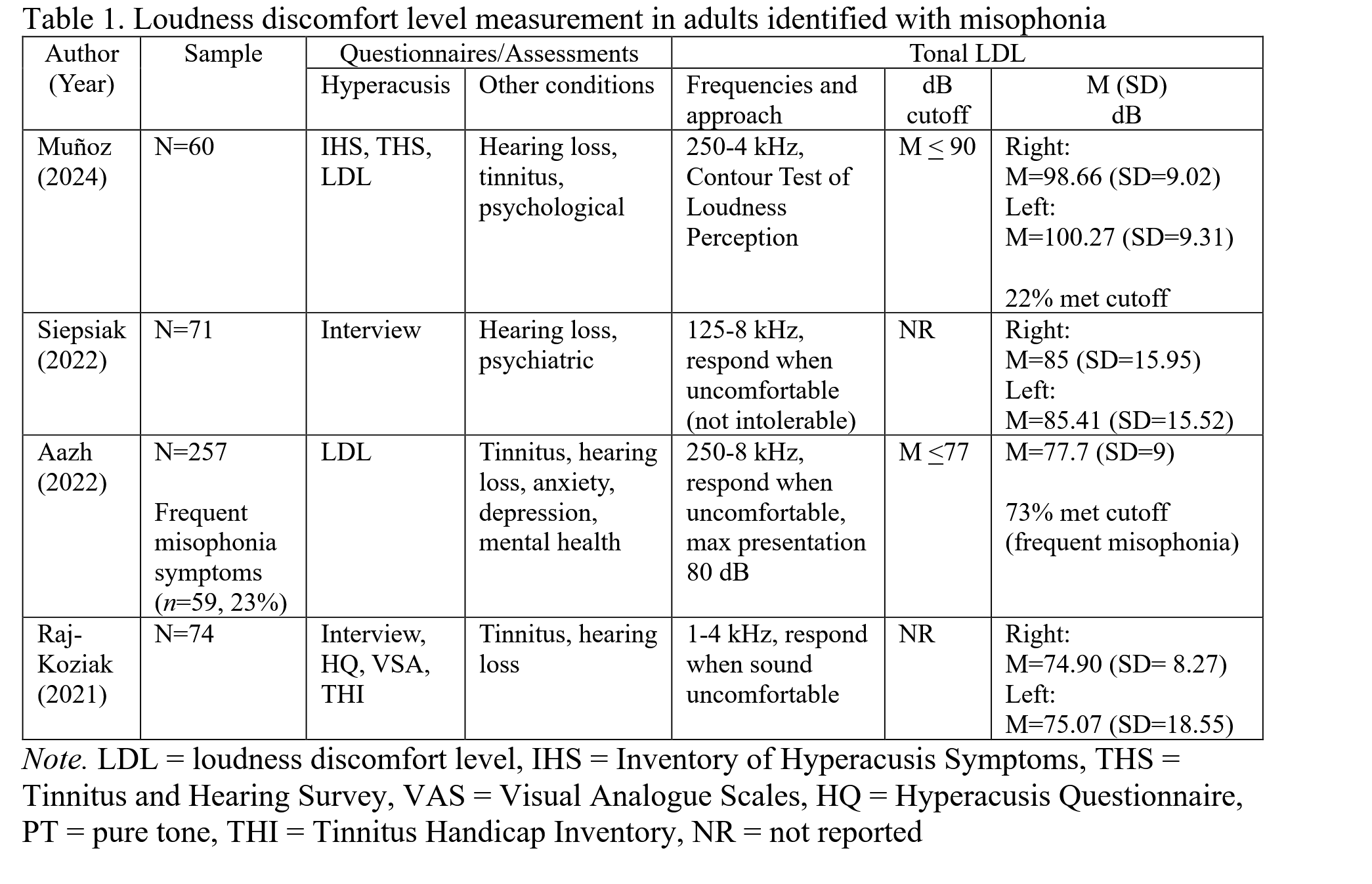
While cautioning against direct comparison of LDLs observed across studies due to no standardized assessments (Woolley et al., 2026b), the Woolley et all discuss how those with co-occurring Misophonia and hyperacusis can have LDLs ranging from 30dB Hl to 120 dB HL, in contrast to the standard < 80dB HL for those with only hyperacusis (Woolley et al., 2026b)
bold-headers
comparing and contrasting Misophonia, hyperacusis, and auditory processing disorder
- although they are similar they are also distinct conditions. broadly speaking, hyperacusis is about the loudness of sounds, Misophonia is selective sensitivity to specific sounds/kind of sounds, and auditory processing disorder (APD) is about issues of processing and interpreting sound in general instead of any sensitivity issues.
- although kids with APD may have any one of these issues, they do not always co occur. (page 2)
bold-headers
Vijayakumar & Ahmmed 2025 implications for audiological traits in Misophonia
A 2025 study evaluating audiometric assessments found that while high-frequency thresholds were lower than low-frequency thresholds across all groups, only the misophonia with hyperacusis group showed a significantly steeper high-to-low slope in the right ear. SRTs did not differ between groups. ULLs were lower in DST groups, especially at 4 kHz, but did not correlate with daily life impact. Tinnitus was more common in DST groups and, in the no DST group, was linked to lower 4 kHz ULLs in the right ear. Past OME history showed no group differences. Overall, routine audiological measures could not reliably differentiate misophonia from hyperacusis. (Vijayakumar & Ahmmed, 2025)
bold-headers
Jastreboff 2023 on the difference between Misophonia and hyperacusis
The major diff between Misophonia and hyperacusis is that in hyperacusis symptoms are the same for any stim, it is dependent on volume. in contrast, Misophonia is mainly about the stim source and identification, and loudness if secondary if relevant at all.. for instance, a Misophonic may react strongly to a trigger but fail to react to another, louder sound. (Jastreboff & Jastreboff, 2023)
Misophonia as a spectrum disorder
bold-headers
Misophonia as a spectrum disorder via Hansen 2026
In a 2026 study, Hansen emphasized the conceptualization of misophonia as a spectrum disorder on the rationale that symptom severity varies continuously in the general population and that neural connectivity differences were detectable only when misophonia was modeled dimensionally rather than categorically. Binary group comparisons failed to reveal significant effects, whereas continuous severity scores were associated with systematic variation in anterior insula connectivity. This supports the view that treating misophonia as present versus absent obscures meaningful variability in neural and behavioral expression (Hansen et al., 2026).
-
10. Clinical & Translational Diagnostic Implications
bold-headers
Guetta 2024 findings on perceived stress and traumatic events in Misophonia
In a 2024 survey study, Guetta et al. aimed to examine the relationships among misophonia, perceived stress, traumatic life events, and PTSD symptoms in a community sample of adults. They assessed 143 U.S. adults with self-identified misophonia using structured clinical interviews and validated self-report measures of stress, trauma exposure, and misophonia severity. They found that perceived stress and hyperarousal symptoms predicted misophonia severity, whereas PTSD diagnosis and lifetime traumatic events did not. From this they concluded that transdiagnostic stress processes, rather than traumatic stress itself, are more strongly related to misophonia severity. from this the authors suggest future work Test transdiagnostic stress-reduction interventions in misophonia. (Guetta et al., 2024).
bold-headers
CNG test identified three factors. mood, social, and Miso-OC
Banker et al. (2022) investigated misophonia’s transdiagnostic structure and social controllability using large-scale self-report data and a modified ultimatum game, analyzed via factor analysis and a 2-step forward thinking model. Factor analysis using the Cattell–Nelson–Gorsuch test revealed three latent dimensions, separating general affective distress (mood), social impairment traits (social), and a distinct cluster combining misophonia and obsessive-compulsive symptoms (Miso-OC), indicating that misophonia does not primarily align with social dysfunction but instead with control-related psychopathology (Banker et al., 2022).