Properties (15)
- purpleRed
- Linking misophonia and tinnitus
- (Melanthiou et al., 2026)
•
Linking misophonia and tinnitus: Common and divergent neurobiological mechanisms
Status:: #status/reviewed
Metadata
- Item Type: #journalArticle
- Authors:: Despina Melanthiou, Georgia Panayiotou, Evangelos Paraskevopoulos, Andreas Chatzittofis, Morfeas Koumas, Anna Onisiforou, Panos Zanos,
- Date:
- Date Added: 1771106225000
- URL: https://linkinghub.elsevier.com/retrieve/pii/S0149763426000394
- DOI: 10.1016/j.neubiorev.2026.106584
- Cite Key: melanthiouLinkingMisophoniaTinnitus2026
- Topics: [object Object]
- Tags:: #to-review, #Highlighted-source, #reference-material, #Misophonia, #literature-review, #seminal-work, #tinnitus, #model, #Hyperacusis,
- PDF Attachments
Abstract
| Background/Purpose | Background- • N/A Purpose- • To provide the first comprehensive review of shared and divergent neurobiological mechanisms (genetic, neural, psychological) underlying misophonia and tinnitus. • To address two questions: (i) what are the shared and divergent neurobiological mechanisms; (ii) how can this information direct more effective diagnostic and therapeutic strategies. • To propose an integrative theoretical model (Sensory-Salience Dysregulation Model) unifying the pathophysiology of both conditions. |
| Participants/samples | • N/A |
| Measures | • N/A |
| Procedures | Lit review |
| Results | • N/A |
| Discussion/Limits | Conclusion- • N/A |
| Limitations:: | • N/A |
| Future Directions:: | • N/A |
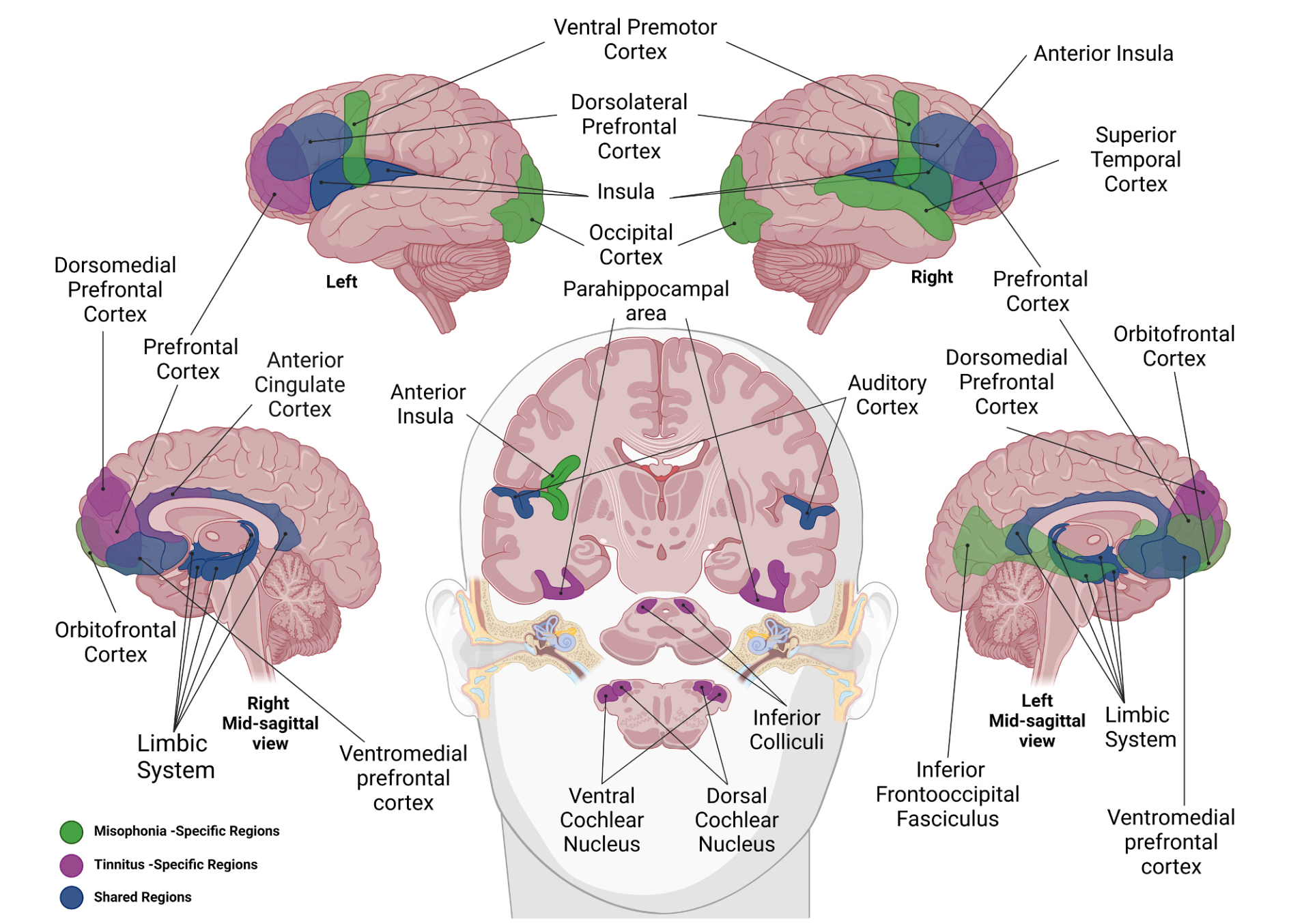
| Relevance:: | • an in depth lit review on both Misophonia and tinnitus, going into great detail about the neurobiological factors for both conditions and how they differ/overlap • describes a “Sensory-salience dysregulation model” to describe both Misophonia and tinnitus. • has some amazing figures to recap the brain areas involved in Misophonia, tinnitus, and where they overlap • a lot of info dense but easy to read recap tables of all current Misophonia related neuro studies + overlapping tinnitus stuff. seriously impressive and useful reference. • a great resource for a recap on the neurobiological basis of Misophonia and tinnitus independently and as comorbidities. this includes a supposed mediating role of hyperacusis for the link between Misophonia and tinnitus. |
Notes
key terms and concepts
- misophonia – a composite neurobehavioral syndrome characterized by intense negative emotional and physiological responses to specific, typically soft, sounds (triggers), including anger, anxiety, autonomic arousal, and avoidance behaviors.
- tinnitus – phantom auditory perception; the hearing of sounds (buzzing, ringing, hissing) in the absence of an external sound source; distinguished as non-bothersome (symptom) or bothersome/distressing (disorder with limbic-autonomic involvement).
- bothersome tinnitus – tinnitus characterized by significant emotional distress, functional disability, cognitive dysfunction, and autonomic dysregulation; distinguished from non-bothersome tinnitus, which typically lacks limbic-autonomic involvement.
- salience network – a brain network comprising the anterior insula, anterior cingulate cortex (ACC), and amygdala that detects emotionally or biologically relevant stimuli and redirects attentional resources.
- hyperacusis – decreased tolerance to ordinary environmental sounds, leading to heightened auditory discomfort or pain; proposed as a potential mediating or risk factor linking tinnitus and misophonia.
- cochlear synaptopathy – damage to synapses between cochlear hair cells and auditory nerve fibers, disrupting temporal coding of auditory information and potentially triggering compensatory central gain increases implicated in tinnitus.
- central gain – compensatory increase in neural responsiveness within central auditory structures following peripheral auditory input reduction, potentially generating or amplifying tinnitus percepts.
- thalamocortical dysrhythmia (TCD) – a theoretical model positing that peripheral deafferentation leads to hyperpolarization of thalamic neurons, altered burst firing via T-type calcium channels, and abnormal low-frequency oscillations propagating through thalamocortical networks, contributing to tinnitus.
- Sensory-Salience Dysregulation Model – a novel unified framework proposed by the authors positing that both misophonia and bothersome tinnitus arise from a primary upstream failure in sensory gating and precision-weighting that causes neutral auditory input to be misclassified as salient or threatening, with salience network overactivation and autonomic dysregulation as downstream consequences.
- predictive coding – a framework proposing that tinnitus (and misophonia) emerge from an imbalance between bottom-up sensory information and top-down predictions; deafferentation or aberrant gating increases sensory uncertainty, causing the brain to rely on maladaptive internal models that manifest as phantom or intrusive percepts.
- frontostriatal gating theory – a theoretical model emphasizing the role of the nucleus accumbens and ventromedial prefrontal cortex (vmPFC) in evaluating and suppressing phantom sounds, with reduced vmPFC gray matter in tinnitus impairing this suppression via the thalamic reticular nucleus.
my engagement notes
my questions
my comments
Bookmarks
-
the neurobiology of misophonia (page 2)
-
bookmark for recap of Neurobiological mechanisms underlying misophonia (page 3)
-
bookmark for Hyperacusis as a potential mediating factor (page 12)
-
bokmark for describing the he sensory-salience dysregulation model: a unified framework for misophonia and tinnitus (page 13)
reading notes
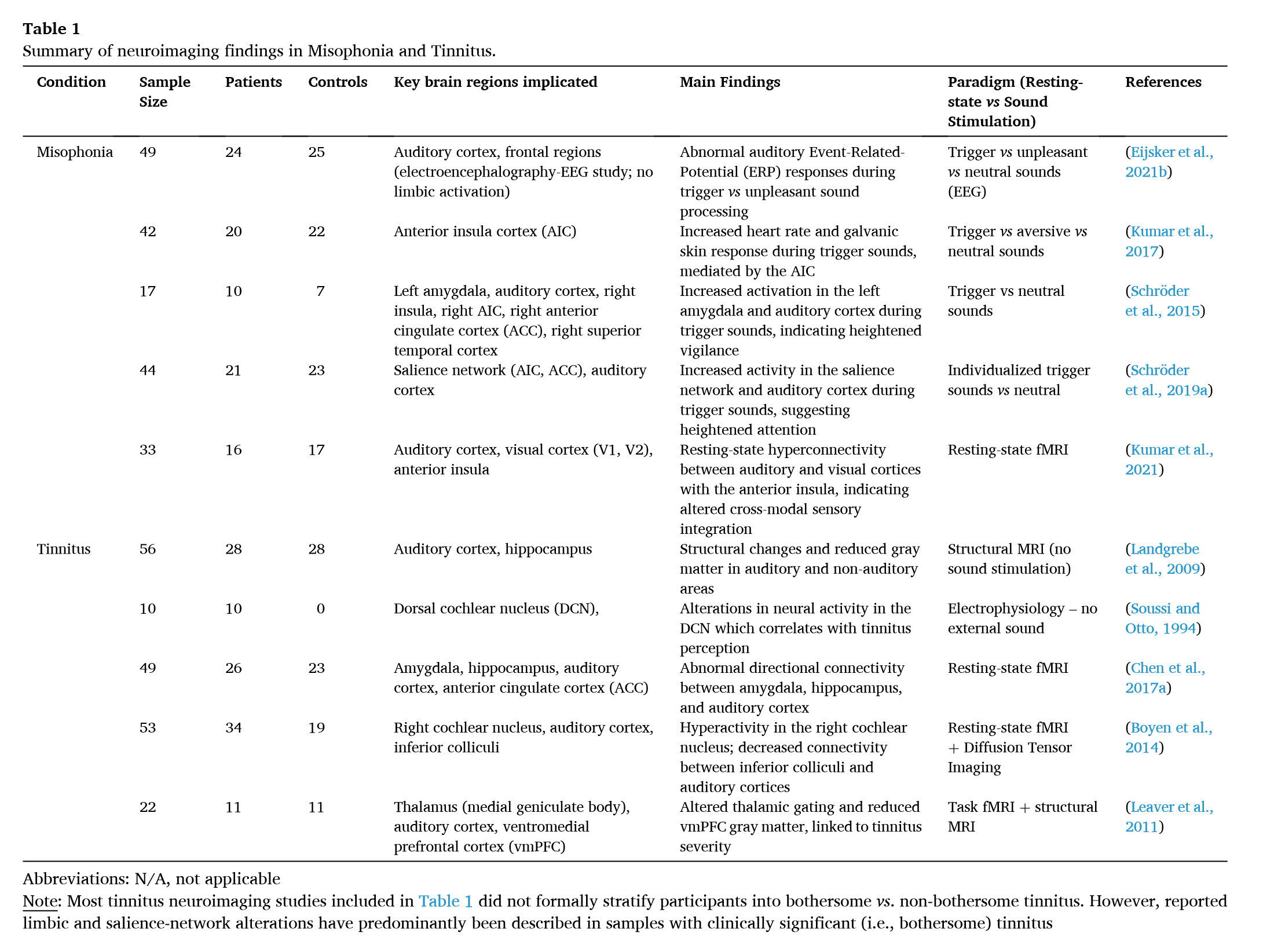
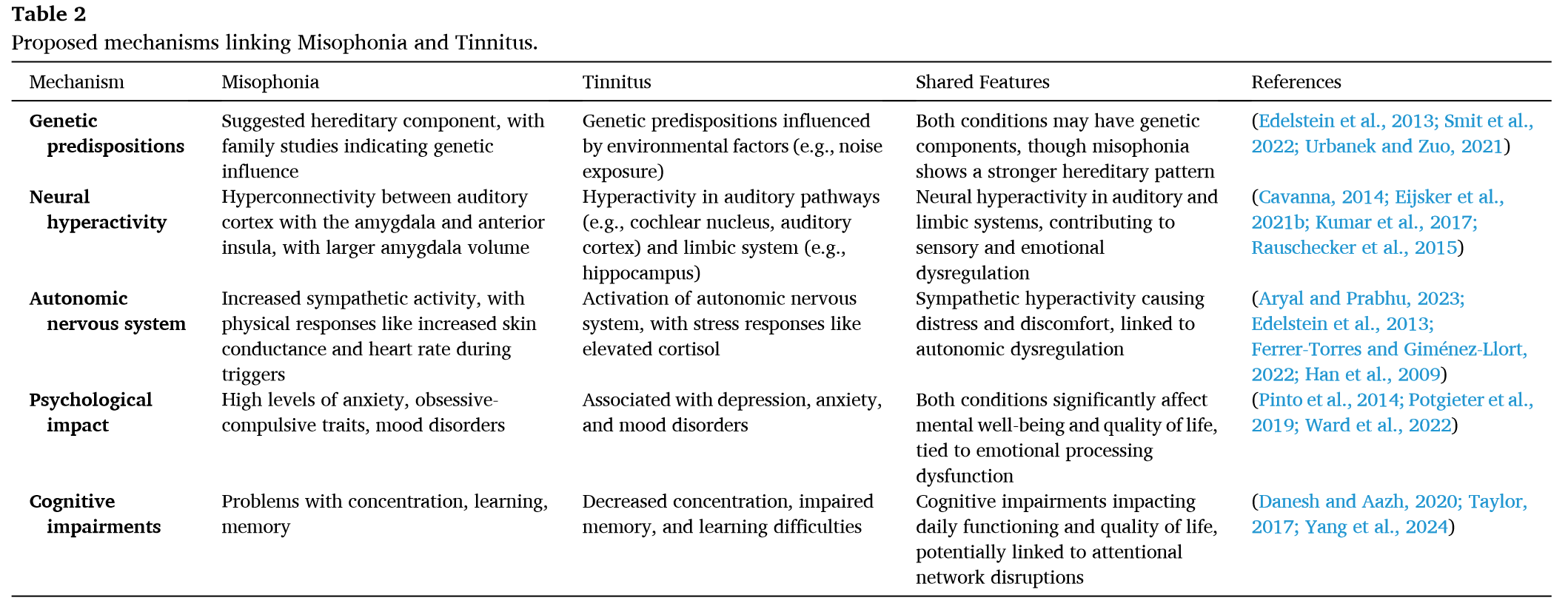
- the authors describes four main predictions made by the SSDM
- symptoms correlating with hyperconnectivity: there will be a strong positive correlation between symptom severity and abnormalities in precision weighting inside the salience network, as evident by hyperconnectivity both at rest and during sound exposure.
- efficacy of neuromodulator interventions: neuromodulator interventions for salience network excitability (e.g., low-frequency or inhibitory patterned TMS to the right anterior insula or dorsal ACC, or excitatory stimulation of dorsolateral prefrontal regions) should reduce distress to sounds regardless of the sounds perceptual qualities.
- Dissociation between perceptual and affective outcomes: modulation of autonomic regulation should reduce symptoms without changing the auditory percept, as the primary dysfunction is in early sensory gating and precision weighting.
- modulating symptom expression via manipulation of sensory precision and expectations: The model proposes that altering sensory precision and expectations, through combined sound-based therapies and cognitive restructuring, can rebalance bottom-up and top-down processing, thereby reducing the salience and autonomic reactivity to auditory stimuli in a way that is empirically testable. (page 14)
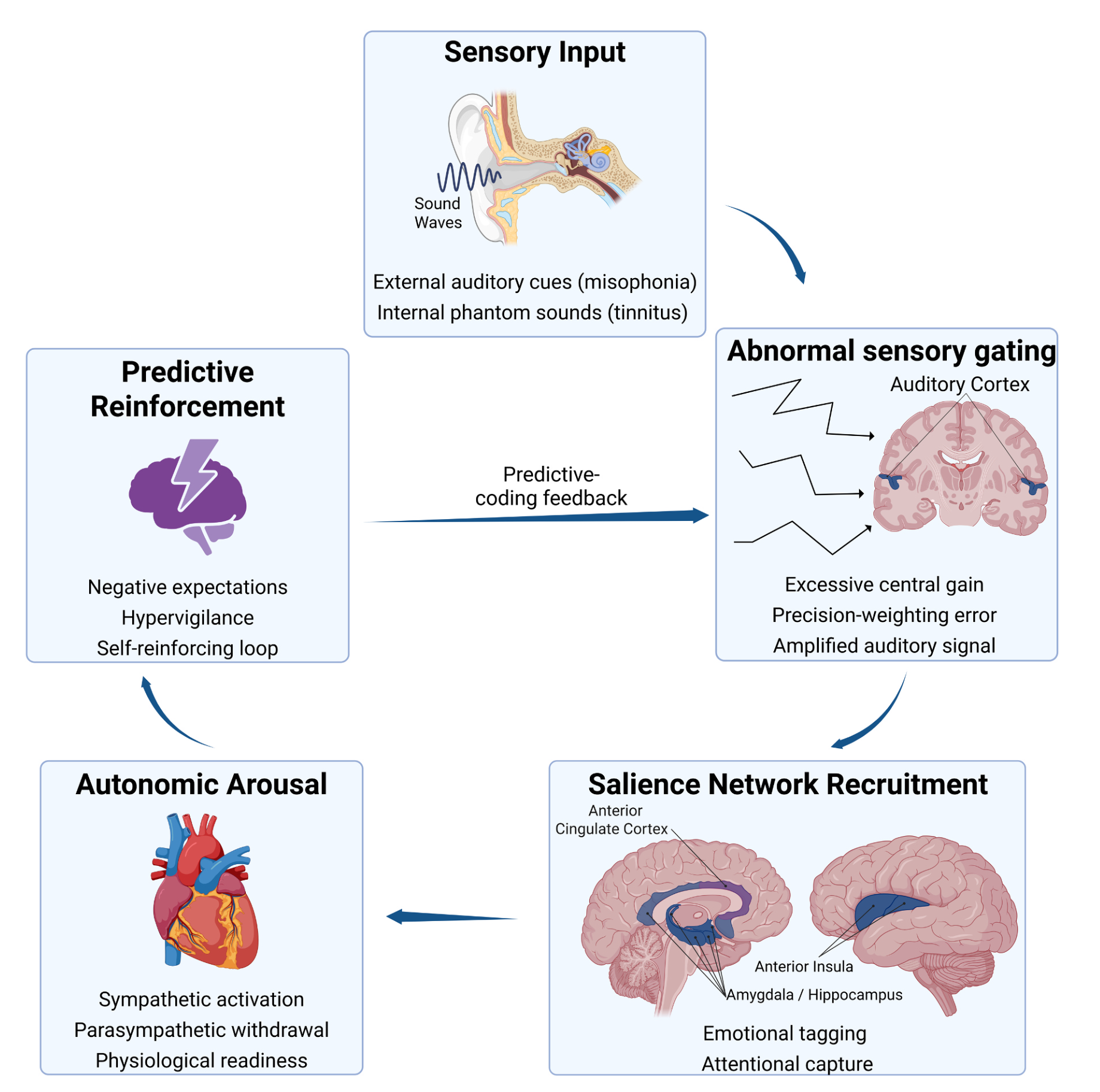
### the sensory-salience dysregulation model
Body
the sensory-salience dysregulation model
(Section link)
(SSDM)
narrative summary
The Sensory–Salience Dysregulation Model (Melanthiou et al., 2026) (SSDM) proposes a unified neurobiological framework for tinnitus and misophonia by emphasizing interacting sensory, salience, and autonomic processes rather than isolated auditory or emotional pathways. Both conditions are understood as arising from abnormal sensory encoding with excessive central gain, where amplified auditory signals emerge either from peripheral damage and compensatory central hyperactivity in tinnitus (producing phantom sounds) or from exaggerated neural responses to specific external triggers in misophonia due to abnormal connectivity between auditory cortex, anterior insula, and premotor regions. These amplified signals then drive overactivation of the salience network (ACC, insula, amygdala), which assigns excessive importance to the sounds and fails to habituate them, causing persistent tagging as salient or threatening and recruiting attentional systems. Finally, the model highlights autonomic dysregulation reinforced through predictive coding errors, where impaired sensory gating increases uncertainty in incoming input, shifting perception toward top-down predictions . Because the brain estimates reliability based on the consistency of sensory input and prior experience (precision Weighting), degraded or noisy input leads it to overweight internal predictions. This results in maladaptive internal models that manifest as phantom percepts in tinnitus and intrusive, emotionally charged responses in misophonia, with these patterns becoming reinforced over time through neuroplasticity.
predictions of the SSDM
the authors describes four main predictions made by the SSDM
- symptoms correlating with hyperconnectivity: there will be a strong positive correlation between symptom severity and abnormalities in precision weighting inside the salience network, as evident by hyperconnectivity both at rest and during sound exposure.
- efficacy of neuromodulator interventions: neuromodulator interventions for salience network excitability (e.g., low-frequency or inhibitory patterned TMS to the right anterior insula or dorsal ACC, or excitatory stimulation of dorsolateral prefrontal regions) should reduce distress to sounds regardless of the sounds perceptual qualities.
- Dissociation between perceptual and affective outcomes: modulation of autonomic regulation should reduce symptoms without changing the auditory percept, as the primary dysfunction is in early sensory gating and precision weighting.
- modulating symptom expression via manipulation of sensory precision and expectations: The model proposes that altering sensory precision and expectations, through combined sound-based therapies and cognitive restructuring, can rebalance bottom-up and top-down processing, thereby reducing the salience and autonomic reactivity to auditory stimuli in a way that is empirically testable.
(Melanthiou et al., 2026)
detailed notes
- a model introduced in (Melanthiou et al., 2026) that seeks to give a unified explanation for the neurobiological framework of both tinnitus and Misophonia
- instead of isolating auditory / emotional pathways.
- sees both Misophonia and tinnitus as arising from three primary sources:
Abnormal sensory encoding with excessive central gain
- Common theme- excessive central gain results in amplified auditory signals
- In tinnitus- peripheral auditory damage (ex hair cell loss, synaptic injury) results in compensatory hyperactivity of central auditory system, creating the persistent phantom sounds
- In Misophonia- exaggerated neural responses the specific external cues resulting from abnormal brin connectivity with the auditory cortex, anterior insula, and premotor regions
Overactivation of the salience network
- common theme- amplified sensory inputs engage salience network (anterior cingulate cortex (ACC), insula, and amygdala), assigning the stimuli more importance. in both instances, salience network fails to downregulate/habituate sounds, and instead continuously highlights and assigns importance to them, which in turn engaging the attentional system due to the sounds being marked as threating.
- In Tinnitus- emotional salience is given to otherwise neutral phantom sound, and hypoconnectivities increases chances of the phantom sound capturing the attention system.
- In misophonia-
autonomic dysregulation reinforced through predictive coding errors
- core issues- failure in up stream sensory gating
- precision weighting- how much the brain weights prediction error (sensory input vs expectations) based on its estimated reliability which is inferred from the consistency of sensory input and prior experience.
- predictive coding – the brain’s process of generating predictions about sensory input and updating them based on the precision-weighted difference between predictions and actual input.
- predictive coding error- the breakdown of predictive coding. applied to the SSDM proposing that tinnitus and misophonia emerge from an imbalance between bottom-up sensory information and top-down predictions; deafferentation or abnormal gating increases sensory uncertainty, causing the brain to rely on maladaptive internal models that manifest as phantom or intrusive percepts.
zettlekasten
hyperacusis as a mediating factor for the Misophonia-tinnitus link
increased neural gain and hyperresponsivity in central auditory pathways as central feature of Misophonia, tinnitus, and hyperacusis