Properties (2)
symptom network model to Misophonia
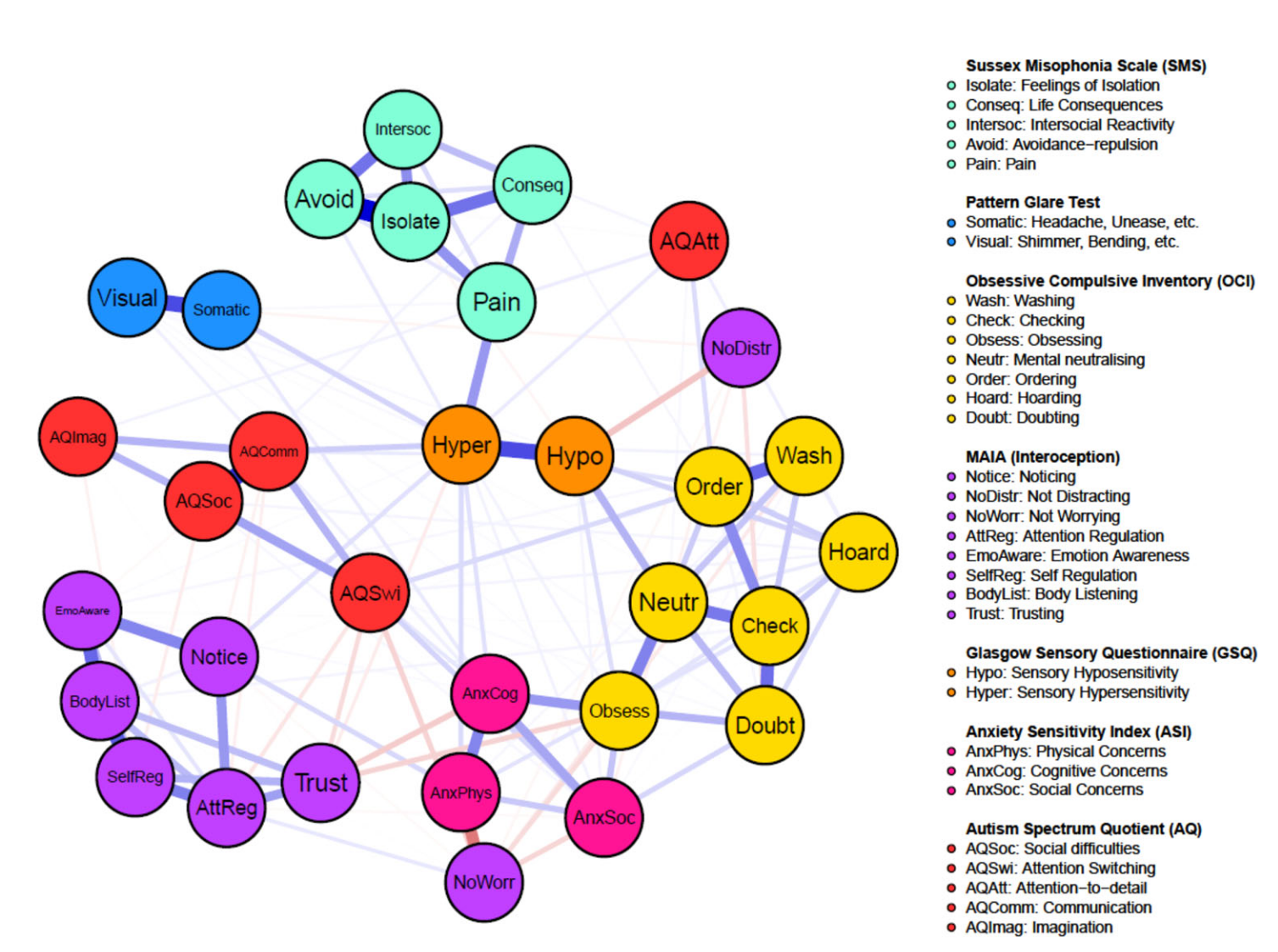
Andermane et al. (2023) modeled misophonia as a symptom network, an approach that treats a disorder not as a single underlying entity but as a web of individual symptoms (nodes) joined by direct relationships (edges estimated as partial correlations, which capture whether two symptoms still track together once every other symptom is accounted for, stripping out links that merely pass through a third symptom). Applied to 419 online participants using 31 nodes drawn from the Sussex Misophonia Scale (SMS), Autism Spectrum Quotient (AQ), Glasgow Sensory Questionnaire (GSQ), Obsessive-Compulsive Inventory (OCI), and Anxiety Sensitivity Index (ASI-3), the model let them gauge each symptom's centrality (how strongly it connects to the rest) and showed sensory sensitivity occupying a central, bridging position. The authors concluded that in this framework comorbidities arise from the mutual influence of symptoms that share connections rather than from one condition causing another, while cautioning that the network is correlational and not a causal model.